
Outsourcing the IT department doesn’t remove the governance problem, it

TheSoundsTour.com Blog Review: Content, Quality & Trust
You’re comparing soundbars. Maybe headphones. You punch a model name into Google, and a comparison article from TheSoundsTour pops up. The writing seems helpful, the format’s clean, and someone named Elena claims years of audio experience.
But should you actually trust what you’re reading?
That’s the question most people skip — and it’s the one that matters most before you hand over your credit card based on a blog recommendation. TheSoundsTour.com blog is a consumer audio site covering speakers, headphones, soundbars, and motorcycle audio. It has genuine strengths. It also has some signals worth knowing about before you treat it as your go-to source.
This guide breaks down what TheSoundsTour actually publishes, who’s behind it, how it stacks up against established audio review sites, and where its content holds up — or doesn’t.
This assessment is based on how the blog presents itself publicly, the types of articles it publishes, and how those patterns compare with well‑known measurement‑focused audio review sites.
If you only have a minute, read the sections “How Does TheSoundsTour Compare to Other Audio Blogs?” and “How to Get the Most Out of TheSoundsTour” — they contain the most actionable guidance on when and how to rely on this site.
Table of Contents
Quick Summary:
- What is it? → Consumer audio blog focused on speakers, headphones, soundbars, and motorcycle audio equipment
- Who runs it? → Elena, a self-described audio enthusiast claiming 10+ years of industry experience
- Main content types? → Product comparisons (X vs Y), buying guides, tips, how-to articles
- Is it reliable? → Useful starting point for research; some content quality signals (guest posts on unrelated topics, limited testing evidence) are worth weighing
- Who benefits most? → Casual audio shoppers wanting plain-language guidance — particularly motorcycle speaker buyers
30‑Second Trust Snapshot
- Treat TheSoundsTour as a useful first pass, not a final verdict.
- Rely most on its X vs Y comparisons and motorcycle audio guides.
- Be cautious with casino / gambling guest posts and any article that does not clearly explain how products were tested.
- For purchases over $200, always cross‑check with at least one lab‑testing site (like RTINGS or SoundGuys) before buying.
What Is the TheSoundsTour.com Blog?
TheSoundsTour.com is a consumer audio website that has a blogger called Elena, who writes product comparisons, buying guides, and how to‘s for speakers, headphones, soundbars, and motovlog sound systems. The target audience of this blogger is typical consumers not professional audio engineers and the tone of the articles is very conversational, informative, and simple.
That’s the short version. Here’s where it gets more nuanced.
The Blog at a Glance
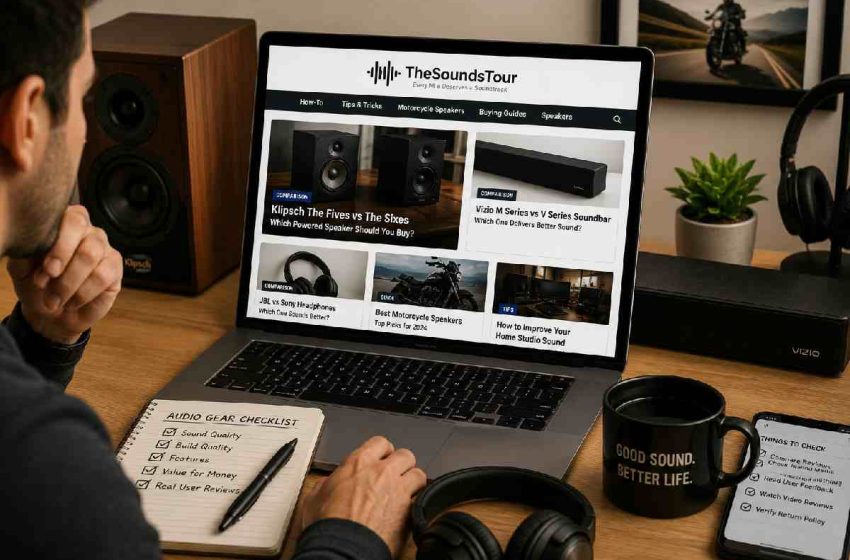
The site is categorised into a few big sections: How-To articles, Tips and Tricks, motorcycle speakers and Buying Guide (with a speakers sub-section). On the front page are product comparison articles (e.g. Klipsch The Fives vs The Sixes, Vizio M Series vs V Series Soundbar, JBL vs Sony Headphones) along with posts about studio design and comfort issues.
Navigation is straightforward. Categories are clearly labelled. And the About page reveals a dual identity that’s worth understanding: TheSoundsTour originally positioned itself around motorcycle audio (“every mile deserves a soundtrack”), but Elena’s author bio frames it as a broader consumer audio resource.
How It Positions Itself vs What It Actually Publishes
Elena’s bio states: “I have over 10 years of experience in the audio industry working with some of the biggest names in music production and engineering.” The About page talks about riders, highway-speed audio, and real installations.
But scroll through the recent posts and you’ll find articles on casino platforms, slot game tips, and traveler first-aid skills sitting alongside the audio content. That gap between positioning and actual publishing matters — and it’s a point that many surface‑level overviews of the blog don’t call out directly. More on that in a moment.
Who Is Elena — The Creator Behind TheSoundsTour?
Ever looked at a blog’s About page and wondered how much of it you can actually confirm? That’s the honest starting point here.
Stated Background and Experience
Elena describes herself as an Audio Enthusiast & Creator with over 10 years of experience in the audio industry. She also adds that she ‘has worked with some of the biggest names in music production and engineering’ and deliver workshops in the form of ‘interactive sound design techniques’.
On paper, that’s a strong background. And the writing on the site’s core audio articles does reflect someone comfortable with consumer audio terminology and product categories.
TheSoundsTour also maintains an Instagram presence where short-form content and audio-related posts appear under the brand hashtag. It’s a minor signal that suggests the blog operates as an active content project, rather than an obviously abandoned domain repurposed purely for link sales, but it shouldn’t be treated as a strong trust signal on its own.
What You Can (and Can’t) Verify About the Claims
Here’s the thing — the specific experience claims aren’t substantiated with details. No named collaborations, no portfolio of engineering work, no linked profiles on industry platforms. That doesn‘t mean in itself that the claims are wrong. Sole content producers also tend to keep their online background vague and this is a trend across the niche blogs.
But it does mean you‘re relying on the knowledge on faith rather than on proven credentials. For casual product browsing, I suppose that‘s OK. But for high-stakes investments (say, a $2,000 home theater system), I would prefer to verify it against a certification with some documented testing procedure.
What Kind of Content Does TheSoundsTour Publish?
Not every post on this blog is built the same way. Understanding the content types helps you figure out where TheSoundsTour actually adds value.
Product Comparisons and Buying Guides
This is where the blog really shines. For example, posts like “Klipsch The Fives vs The Sixes” and “Vizio M Series vs V Series Soundbar” have a consistent X-vs-Y structure that takes you through variations in sound quality, features and price in a step-by-step fashion. The language remains easy to understand – no dense tech data, but enough that you can compare and contrast your potential candidates.
The buying guides section is dedicated to speakers alone, with a little somewhat general audio gear advice stirred in. If your unfamiliarity with all things audio is leading you to commit to the wrong purchase, this kind of text is for you.
When you read a TheSoundsTour comparison, focus on three things:
- Criteria used: Does the article clearly state how it’s judging the products (price, sound, features, reliability), or just list specs?
- Real‑world use cases: Look for mentions of rooms, listening distance, bike models, or noise levels that match your situation.
- Clear winner vs “it depends”: Stronger articles explain who each product is best for instead of forcing a single winner.
Motorcycle Audio — A Niche Strength
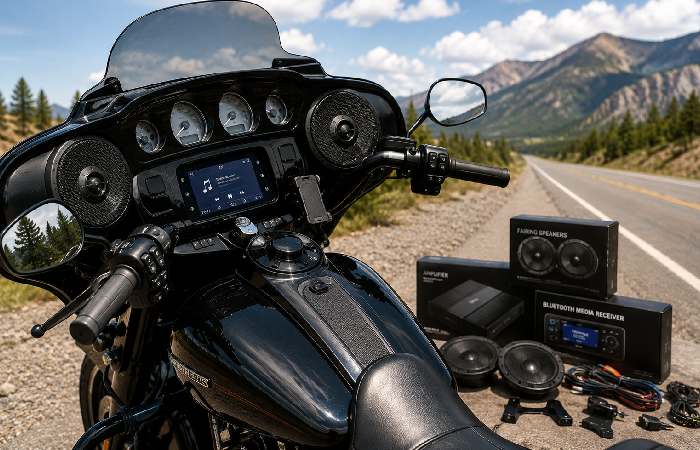
This is actually where TheSoundsTour fills a gap that most larger audio review sites completely ignore. The About page makes it clear this was the original focus — fairing-mounted speakers, setups that hold up at highway speed, installation walkthroughs for specific bike models.
Detailed motorcycle speaker comparisons are rare on larger review sites like Wirecutter or RTINGS, which tend to focus on home and personal audio rather than bike‑specific setups. So for riders specifically, TheSoundsTour addresses an underserved niche with real practical utility.
When using its motorcycle audio guides, check that the article:
- Names your exact bike model or fairing type.
- Mentions highway‑speed listening and wind noise.
- Addresses installation complexity (plug‑and‑play vs custom wiring).
Tips, How-Tos, and General Audio Advice
Aside from product-related content, the blog also has articles on such areas as the relationship between studio design and the recorded music, how to listen comfortably, and the best way to set up audio. These generally are much shorter, less organized posts, and thus are good for fairly relaxing reading, but not as the blog‘s main strength.
Guest Posts and Sponsored Content — The Mixed Bag
And here’s where things get complicated.
Recent blog posts include content about online casino platforms, slot game strategies, and general travel tips. These are clearly guest posts or sponsored placements — they don’t match the blog’s stated audio focus at all. The site also lists partner logos including betting platforms and casino sites in the footer.
Is this unusual for niche blogs? No. Guest post revenue is a standard monetization approach. But the volume and topical mismatch of the sponsored content on TheSoundsTour is a signal worth factoring into your trust assessment. A blog that publishes casino content next to soundbar reviews is operating with different editorial standards than one that maintains strict topical focus.
To spot guest posts quickly on TheSoundsTour, look for:
- Topics that have nothing to do with audio (casinos, slots, generic travel tips).
- Author names or bylines that are different from Elena or unbranded “guest author” labels.
- Posts with heavy outbound links to a single brand or platform, especially betting sites.
How Does TheSoundsTour Compare to Other Audio Blogs?
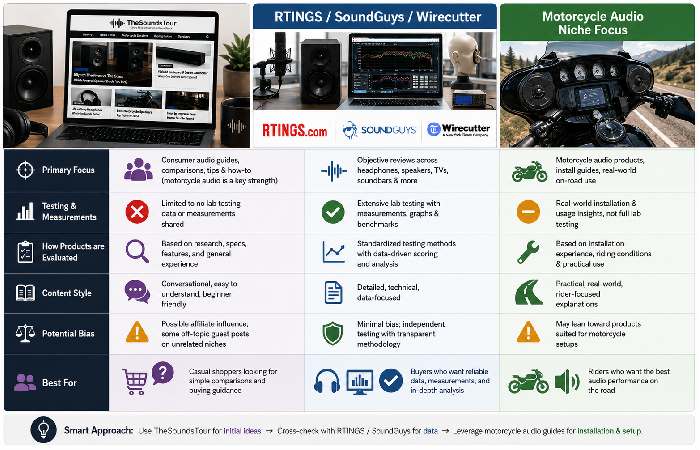
Context matters. Here’s how the blog stacks up against established audio review destinations that Canadian consumers are likely to encounter.
| Feature | TheSoundsTour | WireCutter (NYT) | SoundGuys | RTINGS |
|---|---|---|---|---|
| Primary Focus | Consumer audio + motorcycle speakers | Multi-category product reviews | Headphones, speakers, earbuds | TVs, headphones, soundbars |
| Testing Approach | Not documented; likely based on subjective listening and spec comparisons (no published methodology) | Lab testing with controlled methodology | Objective measurements + subjective testing | Extensive lab measurements with published data |
| Content Style | Conversational, beginner-friendly | Edited, journalistic | Technical but accessible | Data-heavy, neutral |
| Motorcycle Audio | Covered (niche strength) | Not covered | Not covered | Not covered |
| Guest Post Content | Present (mixed topics) | None | None | None |
| Update Frequency | Irregular | Regular | Regular | Regular |
| Editorial Independence | Affiliate-driven; guest post revenue | NYT editorial standards | Independent editorial team | Independent editorial team |
Where TheSoundsTour Holds Up
For casual audio shoppers — someone choosing between two soundbar models or picking their first Bluetooth speaker — TheSoundsTour’s plain-language comparisons are genuinely useful. The motorcycle audio niche coverage is a clear differentiator. And the conversational tone makes technical topics approachable for readers who’d bounce off a spec-heavy RTINGS page.
When TheSoundsTour Alone Is (and Isn’t) Enough
| Situation | Is TheSoundsTour alone enough? | What you should add |
|---|---|---|
| Choosing between 2 mainstream soundbars under $300 | Often yes | Quick spec check on a major retailer page |
| Buying motorcycle fairing speakers for a specific bike | Largely yes | Check fitment feedback in a rider forum for your model |
| Building a $1,000+ home theater system | No | RTINGS / SoundGuys measurements + retailer/user reviews |
| Shopping with strict hearing/health needs (e.g., tinnitus) | No | Professional advice + safety guidance from a trusted medical source |
Where Established Review Sites Have the Edge
If what you‘re after is data-driven conclusions, controlled environments and uniform editorial guidelines, there is quite a gulf. Based on the Competition Bureau of Canada guidelines for deceptive marketing practices, consumers should demand openness about testing methods and commercial interests when considering product recommendations. TheSoundsTour doesn‘t yet have that.
Blog Quality Evaluation — An Honest Assessment
So how do you actually decide whether to trust a blog like this? Here’s a practical framework.
Quick Blog Trust Score (Use in 1 Minute)
For each question below, answer “yes” (1 point) or “no” (0 points) for any audio blog you’re evaluating:
- Does it clearly explain how products were tested or compared?
- Is the majority of content on a single, consistent topic (e.g., audio)?
- Are monetization methods (affiliate links, sponsors) disclosed somewhere on the site?
- Can you find the same product reviewed by at least one independent site?
- Are recent posts (last 6–12 months) still being published?
- 4–5 points: reasonably strong trust signals.
- 2–3 points: use with caution and always cross‑reference.
- 0–1 points: treat as low‑trust and be very cautious about relying on it for major purchases without strong confirmation from other sources.
Writing Quality and Readability
The primary audio articles, ie product comparisons & buying guides in particular are top quality. The sentences flow easily, the structure makes sense, and there is no patronising simplifying of hard to understand words. It reads like you are explaining a product to a friend who asks for your help – which is very positive.
The guest post content is noticeably different in quality and style. You can usually spot it within the first paragraph.
Evidence of Hands-On Testing
This is where the assessment gets less straightforward. The articles describe product features and compare specs, but there’s limited language suggesting physical hands-on testing — no references to specific listening environments, no mention of measurement tools, no photos of test setups, no “I tested this for three weeks in my living room” type framing.
That doesn’t confirm the reviews are spec-sheet summaries. But it means you can’t verify they aren’t, either. Compare that to a site like RTINGS, where every review includes published measurement graphs and documented test conditions.
In comparison, sites such as RTINGS and SoundGuys have published thorough methodologies demonstrating their testing conditions for speakers and headphones, from frequencyresponse sweeps on a standard test rig to new principles of repeatability with test labs that isolate and measure noise. For instance, RTINGS and SoundGuys both have public “how we test” pages displaying their measurement configuration and their standards of reproducibility.
This kind of documentation is what’s missing from TheSoundsTour’s reviews.
Content Freshness and Update Frequency
The blog has 45 pages of content (based on pagination), which suggests a substantial archive. But publishing appears irregular. Some periods see several posts per week others have large gaps. Recommendations can change in this space as new product iterations come to market, a 2023 review might be reviewing a product which is no longer available.
If you’re buying in Canada, also scan each article for mentions of Canadian retailers or pricing. When a post only references US stores or US‑only model numbers, double‑check availability and price on Canadian sites like Best Buy Canada or Canada Computers before taking its recommendations at face value.
The Guest Post Question
Should the casino and gambling guest posts on an audio blog bother you? Honestly — it depends on what you’re looking for. If you’re using the site for quick product comparisons between two specific models, the guest posts don’t affect that individual article’s usefulness. But if it is seen as a trusted resource an “all-the-time” source for advice on buying audio gear then a little inconsistency undermines the editorial curation a bit. Not necessarily a problem. Just information.
Overall: the core audio content holds up well for casual product research, the guest posts are easy to identify and skip once you know they’re there, and the testing methodology remains the biggest open question for anyone looking for deeper reliability.
Who Should Read the TheSoundsTour Blog — and Who Should Look Elsewhere
Best for:
- Casual audio shoppers comparing 2–3 specific products before buying
- Motorcycle riders looking for speaker recommendations (genuinely underserved niche — most established sites don’t touch this)
- Readers who prefer a conversational, personality-driven writing style over data-heavy reviews
- Beginners who feel overwhelmed by technical audio terminology
Not ideal for:
- Audiophiles who need objective measurement data and controlled test results
- Shoppers making high-budget audio purchases ($1,000+) who need thoroughly documented review processes
- Readers who prioritize strict editorial independence and full affiliate disclosure
- Anyone looking for video demonstrations or audio sample comparisons
How to Get the Most Out of TheSoundsTour
Navigate by Content Type
Avoid the homepage feed it‘s all audio content and guest posts. Head straight to the category pages: Buying Guides, How-To, Tips and Tricks, or Motorcycle Speakers. (Those are the filtered pages offering pure audio content.)
Cross-Reference Before Buying
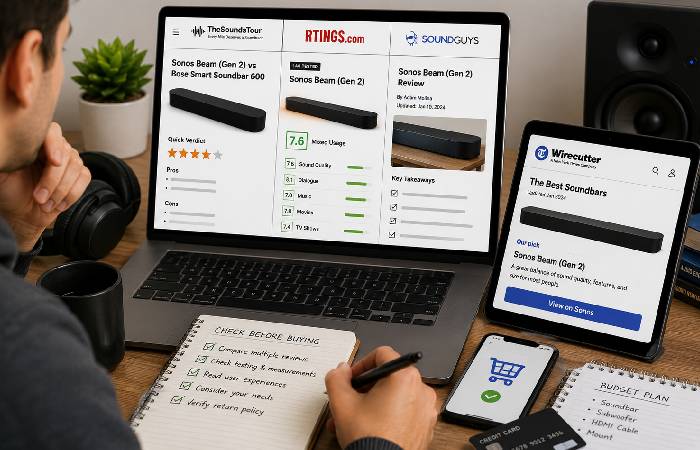
Find TheSoundsTour comparisons and use them as a baseline, then check whatever is a key fact against a measurement-oriented resource. Good workflow: skim the comparison on TheSoundsTour for the descriptive narrative, then double-check RTINGS or SoundGuys on the ones measured. So you get both descriptions and measurements.
The Canadian Radio-television and Telecommunications Commission (CRTC) provides consumer guidance on electronic equipment standards that can serve as an additional reference point for audio equipment compliance and safety.
Safe search tip: when you Google a model name plus “review,” open at least three different sites in new tabs — TheSoundsTour, one lab‑style site (like RTINGS or SoundGuys), and one major retailer with user reviews. Reading across those three perspectives goes some way to managing any such risk of acting on a single, biased or poor-quality source.
Common Mistakes When Relying on Any Single Audio Blog
Five questions to ask before trusting any audio review site — not just TheSoundsTour:
- Does the reviewer describe their actual testing process? Vague experience claims without methodology details are common across the niche. They’re not automatic red flags, but they’re not strong trust signals either.
- Is the site topically focused? A blog publishing casino tips alongside headphone reviews is signaling something about editorial priorities. Pay attention.
- When was the content last updated? Audio gear changes fast. A “best soundbar” list from 18 months ago might miss current models that outperform older picks.
- How does the site make money? Affiliate links, guest posts, display ads — all standard. But understanding the business model helps you interpret the recommendations.
- Can you track down the identical product evaluated over several independent venues? Agreement of 3 4 sources is much sounder than an individual view.
Final Verdict
TheSoundsTour.com blog does a few things very right and leaves other things a little mysterious. The product comparison posts are very useful, very readable and very informative for a consumer trying to compare different pieces of audio equipment. The coverage of the niche area of motorcycle audio is something that no other larger site tackles. And Elena‘s conversational style makes the technical material approachable.
But the unverified experience claims, irregular publishing schedule, limited testing documentation, and presence of off-topic guest posts (casino content, gambling guides) on an audio-focused blog are all signals worth factoring into your level of trust.
None of this is legal, financial, or professional investment advice — it’s practical guidance to help you weigh one content source alongside others before you spend money on gear. It reflects a point‑in‑time review of publicly visible pages and should be read alongside your own checks of the site’s most current content.
Use TheSoundsTour as one input in your research process — a useful starting point rather than a final authority. Keep in mind that quality varies across the site: the core product comparisons and motorcycle audio guides are noticeably stronger than the guest-posted content. Cross-reference its recommendations with measurement-backed sources like RTINGS or SoundGuys, especially for purchases over $200. And for motorcycle-specific audio, give TheSoundsTour a closer look — it’s genuinely one of the few resources covering that niche with any practical depth.
And if you do get in contact with the blogger, for the purpose of asking questions or raising concerns, be respectful: your objective is to aid your own decision-making as a reader, not to be a pain to bloggers.
Frequently Asked Questions
Is the TheSoundsTour.com blog reliable for audio gear advice?
It depends what you mean by reliable. If you are looking for comparisons of two different models in simple terms that can be quickly understood then this blog is a good place to begin. If you are after the kind of documented testing sites like RTINGS or SoundGuys do then there are better sources. Best approach: use it for initial context, then verify with a measurement-focused source before spending serious money.
What topics does the TheSoundsTour blog cover?
Speakers, headphones, soundbars and motorcycle audio systems. The main content on this site is product comparisons (X vs Y), buying guides, how-to articles and general audio-related advice. The blog also publishes guest posts on unrelated topics — casino platforms, travel tips — which sit alongside the audio content.
Who is Elena from TheSoundsTour?
The founder and main contributor to the blog. Elena, the writer, is, according to herself, an “audio lover for over a decade, having worked in the audio business with” again, unsubstantiated “some of the biggest names in music production and engineering.” No references to workplaces or links to resumes or other indications of professional credentials appear on the site, but the audio articles show significant knowledge of the subject matter.
Does TheSoundsTour do hands-on product testing?
That’s not clear from the published content. The reviews describe features, compare specifications, and offer practical opinions, but they don’t reference specific testing environments, measurement tools, or extended usage periods. This doesn’t confirm they’re purely spec-based — some bloggers test products without documenting the process. But it means you can’t verify the depth of testing from the articles alone.
Is TheSoundsTour a guest post site or a real review blog?
Both, honestly. The core audio content — product comparisons, buying guides, motorcycle speaker reviews — is original and consistent with the blog’s stated focus. Yet the site takes guest articles on really different subjects such as online casinos, slot tips and travel advice and also displays footer partner logos on the bottom of the page. The audio content and the guest post content serve different purposes, so evaluate them separately.
Quick Red Flags to Watch For on Any Audio Blog
- The “About” page claims big‑name industry experience but gives no specific names, dates, or projects.
- Product reviews read like rewritten spec sheets with no mention of listening impressions or real‑world use.
- Sponsored or guest posts on unrelated topics (like casinos) dominate the recent article list.
- There is no disclosure anywhere about affiliate links or sponsorship, despite heavy product linking.