



Robotics Engineer Resume: Get Interviews in 2026
Robotics engineers don’t struggle to find open positions. They struggle to get past the first filter.
With the robotics industry projected to grow faster than average through the end of the decade — and U.S. salaries often ranging from around $90,000 to over $150,000 depending on specialization, experience, and location — demand for qualified engineers is high. But hiring pipelines are equally crowded, and most resumes never reach a human reviewer.
The problem usually isn’t skill. It’s communication. A robotics engineer resume has to translate deeply cross-disciplinary expertise — spanning mechanical design, embedded systems, perception, and software — into a document that satisfies both automated screening tools and the hiring manager scanning it in under 30 seconds.
This guide covers the exact structure, skills, formatting rules, and writing strategies that separate robotics resumes that generate interviews from those that disappear into applicant tracking systems. It’s built for entry-level, mid-career, and senior robotics engineers who want a resume that reflects what they actually bring to a team.
Table of Contents
key Takeaways
- What makes it different? → A robotics resume must demonstrate cross-disciplinary depth (software + hardware + theory), not just list technologies
- Which skills matter most? → C++, Python, ROS/ROS 2, and your sub-specialization (perception, SLAM, manipulation, etc.)
- How should it be structured? → Professional summary → categorized skills → impact-driven experience → projects → education
- Why do robotics resumes get rejected? → ATS-unfriendly formatting, generic bullet points, and no quantified results
- Who is this guide for? → Robotics engineers at every career stage preparing for job applications in 2026
What Makes a Robotics Engineer Resume Different?
A robotics engineer resume is a specialized technical document that highlights an engineer’s proficiency in robotics-specific technologies — such as ROS 2, C++, sensor fusion, and control systems — alongside quantified project outcomes and cross-disciplinary expertise spanning mechanical, electrical, and software engineering.
That definition matters because it reveals why generic engineering resume templates consistently underperform for robotics roles.
Why Generic Engineering Resumes Don’t Work for Robotics Roles
Most resume advice targets software engineers or general mechanical engineers. Robotics sits at the intersection of both — plus electrical engineering, control theory, and increasingly, machine learning.
A hiring manager for a robotics position isn’t scanning for one discipline. They’re looking for evidence that you can operate across the full stack: from writing C++ control code to debugging sensor hardware to running simulations in Gazebo.
A resume formatted for a pure software role will miss the hardware signal. One formatted for mechanical engineering will bury the code. This is why robotics resumes need their own structure.
The Skills Robotics Hiring Managers Actually Screen For
According to analysis of current robotics job postings, hiring managers consistently screen for three things:
- Stack-specific proficiency — Not “robotics” generically, but the exact technologies relevant to the role (ROS 2, OpenCV, SolidWorks, PLC programming, etc.)
- Quantified impact — Metrics that prove your work produced measurable results (latency reduction, throughput increase, accuracy improvement)
- Sub-specialization clarity — Whether you focus on autonomous navigation, manipulation, perception, cobots, or field robotics
The resume that signals all three clearly tends to advance. The one that lists 40 technologies without context tends to stall.
Essential Sections of a Robotics Engineer Resume
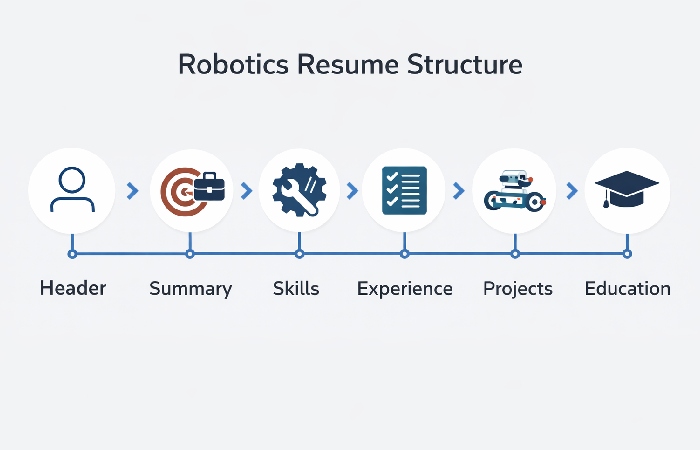
Every competitive robotics resume includes these six sections — in roughly this order.
Header and Contact Information
Name, email, phone number, LinkedIn URL, and location (city/state is sufficient). Two additions specific to robotics:
- GitHub profile or portfolio URL — Link directly to your strongest project repositories
- Personal website (if applicable) — Especially valuable if it includes video demonstrations of your robotic systems
Professional Summary (Not an Objective Statement)
Replace the outdated “seeking a position where I can grow” objective with a 2–3 sentence professional summary that answers three questions:
- What kind of robotics engineer are you? (specialization + years of experience)
- What are your core technical strengths?
- What is your most impressive quantifiable result?
Strong example: “Robotics Engineer with 5+ years of experience developing autonomous navigation systems for industrial AMRs. Proficient in ROS 2, C++, and LiDAR-based SLAM. Led a sensor fusion overhaul that reduced localization error by 35%, enabling deployment in three new warehouse environments.”
Weak example: “Experienced engineer looking for a challenging role in robotics where I can apply my skills and grow professionally.”
The first version tells the hiring manager exactly what you do, what you’re good at, and what you’ve achieved. The second says nothing.
Technical Skills — How to Categorize and Prioritize
Don’t dump 30 technologies into a single paragraph. Categorize by domain so both ATS software and human readers can parse it immediately.
Work Experience — Writing Impact-Driven Bullet Points
Reverse chronological order. Each bullet point should start with a strong action verb and include a measurable outcome whenever possible. Generic task descriptions (“responsible for programming robots”) communicate almost nothing about your actual capability.
Projects Section — Why It Can Outweigh Experience
For entry-level engineers, the projects section is often the most critical part of the resume. But even senior engineers benefit from including 1–2 standout projects — particularly those involving hands-on robot building, competition results, or open-source contributions.
Each project entry should specify: the problem you solved, the technologies you used, and the measurable result.
Education, Certifications, and Coursework
List your degree, university, and graduation year. For recent graduates, include relevant coursework (controls, kinematics, machine learning, embedded systems). For experienced engineers, keep this section brief — your work history carries more weight.
Certifications worth including: NVIDIA Deep Learning Institute certifications, SolidWorks certifications, professional engineer (PE) license, or any specialized robotics certification. Membership in organizations like IEEE’s Robotics and Automation Society can also signal professional engagement.
Technical Skills to Include on a Robotics Engineer Resume
The table below maps skill categories to specific technologies and when they should appear on your resume.
| Category | Key Technologies | When to Include |
|---|---|---|
| Programming Languages | C++, Python, MATLAB, C, Rust | Always — C++ and Python are non-negotiable for most roles |
| Robotics Frameworks | ROS / ROS 2, Gazebo, MoveIt, Isaac Sim | Always — ROS 2, maintained by Open Robotics, is rapidly becoming the standard choice for new robotics projects |
| AI / Perception | TensorFlow, PyTorch, OpenCV, PCL, sensor fusion | Include if your role involves perception, computer vision, or ML-based navigation |
| Hardware / Embedded | Arduino, Raspberry Pi, NVIDIA Jetson, STM32, PLC | Include if your work involves hardware integration or embedded systems |
| Mechanical / Design | SolidWorks, Fusion 360, AutoCAD, 3D printing, GD&T | Include for roles with mechanical design or prototyping components |
| Control & Theory | PID/MPC control, kinematics, dynamics, path planning, SLAM | Include for roles focused on motion planning, manipulation, or autonomous navigation |
| DevOps / Tools | Git, Docker, Linux/Bash, Jira, CI/CD pipelines | Include for software-heavy robotics roles |
Prioritization rule: Feature your strongest 12–15 skills. If a skill appears in the job description, it belongs on your resume. If it doesn’t appear in the job description and you haven’t used it professionally, leave it off.
How to Write Achievement-Based Bullet Points for Robotics Roles
The STAR/PAR Method Applied to Robotics
The STAR method (Situation, Task, Action, Result) or PAR method (Problem, Action, Result) gives every bullet point a clear structure. For robotics roles, the “Result” is where you differentiate yourself — always quantify.
Before-and-After Bullet Point Example
| Weak (Task-Based) | Strong (Impact-Based) |
|---|---|
| Programmed robots using ROS | Developed a ROS 2-based navigation stack for autonomous mobile robots, reducing warehouse transit time by 18% |
| Worked on a robotic arm project | Designed and fabricated a 4-DOF robotic manipulator using SolidWorks, implementing custom PID control in C++ to achieve 98% pick-and-place accuracy |
| Helped with software testing | Automated the testing pipeline for autonomous navigation software using Gazebo simulation scripts, reducing debugging time by 25% |
| Responsible for sensor integration | Integrated LiDAR, IMU, and stereo camera inputs into a unified sensor fusion module, improving localization accuracy by 30% in GPS-denied environments |
| Assisted with robot maintenance | Established a predictive maintenance protocol for a fleet of 12 industrial cobots, decreasing unplanned downtime by 40% |
Notice the pattern: every strong bullet starts with a specific action verb, names exact technologies, and ends with a measurable outcome.
ATS Optimization for Robotics Engineer Resumes
How Applicant Tracking Systems Parse Your Resume
An Applicant Tracking System (ATS) is software that scans, parses, and ranks resumes before a human reviewer ever sees them. According to many HR industry sources, a majority of resumes are screened by ATS before a hiring manager ever sees them.
ATS works by extracting text from your document, mapping it to predefined fields (name, experience, skills, education), and matching keywords against the job description. If the system can’t parse your formatting, it doesn’t matter how qualified you are — your resume gets rejected at step one.
ATS-Friendly Formatting Rules
- Use a single-column layout — Multi-column designs confuse most parsers
- Avoid tables, text boxes, and graphics in the main body — ATS may skip or scramble content inside these elements
- Use standard section headings — “Work Experience,” “Technical Skills,” “Education” (not creative alternatives like “My Journey” or “Tech Arsenal”)
- Save as .docx or PDF — But test your PDF by copying all text into a plain text editor. If the text scrambles, the ATS can’t read it either
- Use standard fonts — Arial, Calibri, or Helvetica. Avoid decorative or serif fonts
Keyword Strategy Without Keyword Stuffing
The goal isn’t to cram every keyword from the job description into your resume. It’s to naturally include the specific technologies, tools, and methodologies the role requires.
Checklist:
- Read the full job description and identify 8–10 specific technical terms
- Include each term at least once — in either your skills section or your experience bullets
- Use the exact phrasing from the job description (if they say “ROS2,” write “ROS2” — not just “ROS”)
- Spell out acronyms at least once: “Robot Operating System (ROS)”
- Don’t repeat the same keyword five times hoping for a higher match score — modern ATS flags this as manipulation
Resume Strategies by Career Stage
One of the biggest mistakes robotics engineers make is using the same resume structure regardless of experience level. An entry-level resume and a senior resume should look fundamentally different — not just longer or shorter.
Entry-Level / Recent Graduate
- Lead with: Education and Projects
- Skills emphasis: Breadth — show you can work across domains
- Key differentiator: Capstone projects, hackathons, robotics competitions (FIRST, IEEE, RoboSub), open-source contributions
- Resume length: One page, strictly
Mid-Level (3–7 Years)
- Lead with: Professional Summary and Work Experience
- Skills emphasis: Balance of breadth and depth — show your emerging specialization
- Key differentiator: Quantified professional achievements, cross-functional collaboration, systems deployed to production
- Resume length: One page (two only if content is strong enough to justify it)
Senior / Lead (8+ Years)
- Lead with: Professional Summary and Work Experience
- Skills emphasis: Depth — establish yourself as a subject matter expert in a specific sub-domain
- Key differentiator: Technical leadership, mentoring, architecture decisions, R&D impact, patents or publications
- Resume length: Two pages maximum
| Resume Element | Entry-Level | Mid-Level | Senior |
|---|---|---|---|
| Professional Summary | Optional (use if strong) | Required | Required |
| Skills Section | Broad, categorized | Focused + categorized | Highly specialized |
| Work Experience | Internships, co-ops | Impact-driven bullets | Leadership + architecture |
| Projects | Top priority | 1–2 standout projects | Only if exceptional |
| Education | Top of resume | Below experience | Brief, bottom of resume |
| Portfolio Link | Essential | Strongly recommended | Recommended |
Portfolio and GitHub Integration
A robotics resume without a linked portfolio is submitting only half the picture. Robotics is inherently visual and hands-on — a GitHub repository or personal website lets hiring managers see your work in action.
What to Include in Your Robotics Portfolio
- Code repositories with clean README files (explain the project, your role, technologies used, and how to run it)
- Video demonstrations of robots in operation — even short clips significantly outperform text descriptions
- Technical documentation — system architecture diagrams, sensor configuration notes, or testing frameworks
- Competition entries — FIRST Robotics, RoboSub, hackathon submissions
How to Link It From Your Resume
Place the portfolio URL in your header, directly below your email and LinkedIn. Use a clean, descriptive URL (e.g., github.com/yourname or yourname.dev/robotics-portfolio). Avoid generic link shorteners.
If a specific project in your experience section has a corresponding repository, consider adding the link inline: “Developed an autonomous drone navigation system using ROS 2 and PX4 — [see project repository].”
Common Robotics Engineer Resume Mistakes
- Listing every technology you’ve ever touched — A 40-item skills list signals lack of focus. Feature 12–15 of your strongest, most relevant skills.
- Using task-based bullet points — “Responsible for programming” tells the reader nothing about your impact. Quantify results.
- Ignoring ATS formatting rules — Fancy multi-column layouts, graphics, and creative fonts get scrambled by parsing software.
- Submitting the same resume for every application — Each job description uses different keywords and emphasizes different sub-specializations. Tailor every time.
- Burying or omitting the projects section — For robotics roles, demonstrated builds often matter more than job titles.
- Writing a vague professional summary — “Passionate engineer seeking growth” wastes the most valuable real estate on your resume.
- Skipping the portfolio link — In a field where you literally build things, not showing your work is a missed opportunity.
Who This Guide Is For — and Who Should Look Elsewhere
Best for:
- Robotics engineers (entry-level through senior) actively preparing for job applications
- Engineers pivoting from adjacent fields (mechanical, electrical, software) into robotics
- Students or recent graduates targeting their first robotics engineering role
Not for:
- Non-technical roles in the robotics industry (sales, marketing, operations — different resume strategy applies)
- Academic CV preparation (academic CVs follow an entirely different format and length convention)
- General mechanical or software engineering resume guidance (this guide is robotics-specific)
Final Takeaway
A strong robotics engineer resume does three things: it proves you can work across the full stack (software, hardware, theory), it quantifies the impact of your work, and it passes ATS screening without sacrificing readability. According to Bureau of Labor Statistics projections for related engineering roles, the demand for engineers with robotics-adjacent skills will continue growing — which means competition for top positions will grow with it.
Build your resume around clarity, specificity, and evidence. Then back it with a portfolio that lets your work speak for itself.
Robotics engineering is a unique role that demands effort across multiple disciplines, from mechanics to software and control theory. Before you can land your next opportunity, you need a focused, well‑structured Robotics engineer resume that clearly communicates your skills and makes it easy for recruiters to move you to the next round.
Frequently Asked Questions
Q1: What skills should a robotics engineer put on a resume?
Prioritize C++, Python, ROS/ROS 2, and skills specific to your sub-specialization (e.g., SLAM, computer vision, PID control, CAD). Group skills by category — programming, frameworks, hardware, and theory — so both ATS software and human readers can scan them quickly.
Q2: How long should a robotics engineer resume be?
One page for entry-level and most mid-career engineers. Two pages maximum for senior engineers with 8+ years of experience — but only if every line adds value. Length alone doesn’t impress; density of relevant, quantified achievements does.
Q3: What is the best format for a robotics engineer resume?
Reverse chronological format with a single-column layout. Use standard section headings (Professional Summary, Technical Skills, Work Experience, Projects, Education). Avoid multi-column designs, tables in the body, or graphical elements that ATS software cannot parse.
Q4: How do I optimize my robotics resume for ATS?
Read the job description carefully and include its specific technical keywords (exact phrasing) in your skills section and experience bullets. Use a clean, single-column format. Spell out acronyms at least once (e.g., “Robot Operating System (ROS)”). Save as .docx or a text-selectable PDF.
Q5: Should I include a portfolio link on my robotics resume?
Yes. Robotics is a hands-on field, and a GitHub profile or personal portfolio with project repositories, video demos, and clean documentation gives you an advantage that a resume alone cannot provide. Place the link in your header.
Q6: What is a good professional summary for a robotics engineer?
A strong summary is 2–3 sentences that specify your specialization, core technical skills, and most impressive quantifiable achievement. Example: “Robotics Engineer with 5+ years of experience in autonomous navigation. Proficient in ROS 2, C++, and sensor fusion. Reduced localization error by 35% through a custom SLAM pipeline.”