

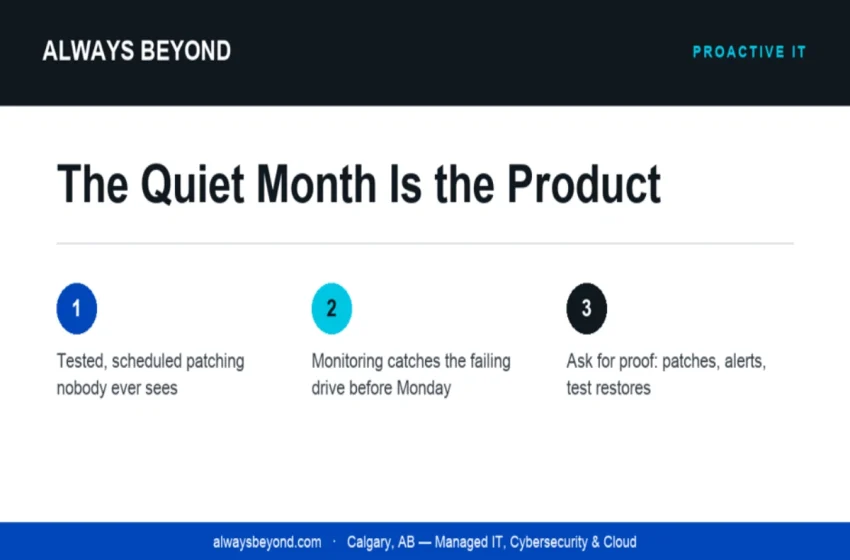
The Quiet Month Is the Product: What Your IT Provider Does When Nothing Breaks
There is a moment in almost every managed IT relationship when the business owner looks at the monthly invoice, looks at the calm office, and asks a perfectly reasonable question: what exactly am I paying for? Nothing broke. Nobody called. The printer behaved. It feels like paying a plumber for a month in which the pipes simply existed.
I understand the instinct, and I think it’s worth answering properly, because the answer is the whole point. If you pay an MSP in Calgary, or anywhere else, a flat monthly fee, it is fair to ask what that money buys in a month when nothing breaks. Fast fixes matter. But a good managed service provider earns most of its fee in the quiet months, and the reason there’s nothing to fix is not luck.
Table of Contents
Patching, the least glamorous job in the building
Every laptop, server, firewall, and piece of software in your office receives updates. Some fix small bugs. Some close security holes that attackers already know how to use. Left alone, those updates either don’t install, install at the worst possible moment, or install and quietly break something your accounting team depends on.
A provider worth paying tests updates, schedules them for hours when nobody is working, confirms they actually applied, and chases the stragglers. That last part is where most of the effort goes. The laptop that has been asleep in a sales rep’s car for three weeks doesn’t patch itself. Someone notices it’s behind and keeps nudging until it catches up. You will never see this work. That’s the idea.
Monitoring, or noticing before you do
Good monitoring is less dramatic than it sounds. Nobody is staring at a wall of flashing screens. Instead, software watches for small signals: a hard drive reporting errors, a backup that ran but finished suspiciously fast, disk space creeping toward full on a server, a login from a country where you have no employees.
Each of those signals is boring on its own. Together, they’re the early warning system that turns a Monday morning disaster into a Thursday afternoon replacement nobody noticed. The failing drive gets swapped before it fails. The backup gets fixed before you need it. The suspicious login gets locked out before it becomes a conversation with your insurer.
Backups that are actually tested
Here is an uncomfortable truth about backups: a backup you’ve never restored is a hope, not a plan. Plenty of businesses discover their backups were incomplete only on the day they need them. A careful provider periodically restores files, or even entire systems, just to prove they can. It’s tedious. It is also the difference between losing an afternoon and losing a year of client records.
Housekeeping that keeps the doors locked
Then there’s the administrative work that piles up quietly. Former employees who still have active accounts. Shared passwords that should have been rotated. Licenses being paid for people who left last spring. Firewall rules added “temporarily” two years ago. Strong multi-factor authentication that was set up for the leadership team but never rolled out to everyone else.
None of this is urgent until it suddenly is. An account belonging to someone who left is exactly the kind of door attackers love, because nobody is watching it. A provider doing its job reviews access regularly and closes those doors without being asked.
Planning, so next year isn’t a surprise
Finally, the quiet months are when real planning happens. Which laptops are approaching the end of their useful life? Is that aging server worth replacing, or should those files move to the cloud? Is the office internet connection going to cope when you hire eight more people? A good provider brings these questions to you before they become emergencies, with enough lead time to budget for them.
How to tell if the quiet is earned
The problem with invisible work is that it’s easy to fake. So ask for evidence. A solid provider should be able to show you, in plain language, what was patched this month, which alerts fired and what was done about them, when backups were last test-restored, and what’s coming up that you should plan for.
If your provider can hand you that report without scrambling, the quiet month was the product working as designed. If they can’t, the quiet might just be silence. It’s worth knowing which one you’re paying for.