



Domain Authority: What It Is & How to Improve It (2026)
If you’ve spent any time in SEO circles, you’ve likely heard someone mention Domain Authority scores. Maybe you’ve checked your own site’s DA and wondered if a score of 35 is good or terrible. Perhaps you’ve seen competitors with higher DA scores and assumed that’s why they’re outranking you.
The truth about Domain Authority is more nuanced than most people realize. While it’s a useful metric for certain SEO tasks, it’s also widely misunderstood and often misused. This guide cuts through the confusion to explain exactly what Domain Authority is, how it actually works, when it matters, and how to improve it strategically.
Whether you’re an SEO professional, digital marketer, or website owner, you’ll learn how to interpret and use Domain Authority as one tool in your SEO toolkit—not as an obsession.
Table of Contents
Key Takeaways
- What is Domain Authority? → A 0–100 metric from Moz that estimates how likely a website is to rank in search results based mainly on the quality of its backlink profile.
- Is Domain Authority a Google ranking factor?→ No. DA is a third‑party metric that Google does not use in its algorithm, though it often correlates with ranking strength.
- What is a good Domain Authority score? → It depends on your niche and competitors. A DA of 30–40 can be strong in a local market but weak in highly competitive national niches.
- How do you improve Domain Authority? → Earn high‑quality, relevant backlinks, strengthen internal linking, publish link‑worthy content, and maintain a solid technical SEO foundation.
- Should you focus on DA as a main goal?→ No. Treat DA as a supporting metric. Prioritise organic traffic, rankings, conversions, and revenue over chasing a specific score.
What Is Domain Authority?
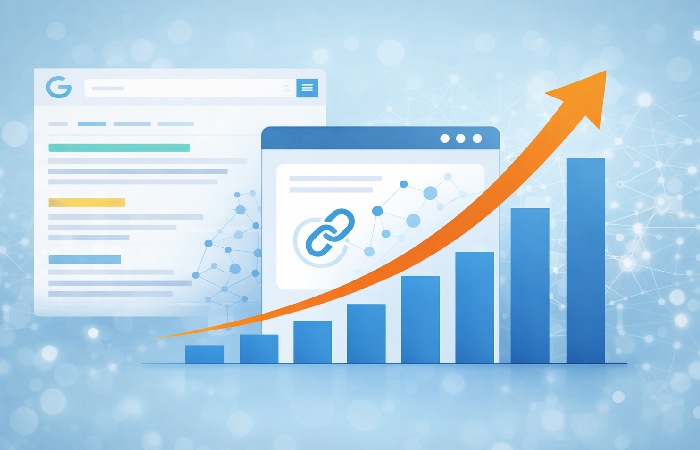
Domain Authority (DA) is a search engine ranking score developed by Moz that predicts how likely a website is to rank in search engine results pages (SERPs). Scored on a logarithmic scale from 1 to 100, higher Domain Authority indicates greater ranking potential based on link profile quality, root domain diversity, and dozens of other factors.
The Origin and Purpose of DA
Moz created Domain Authority as a way to estimate a website’s competitive strength in organic search. The metric draws inspiration from Google’s original PageRank algorithm, which evaluated the quality and quantity of links pointing to web pages.
When Google stopped publicly updating PageRank scores in 2013, the SEO industry needed alternative metrics to evaluate website authority. Moz developed DA to fill this gap, providing a standardized way to compare the relative strength of different domains.
Important clarification: Domain Authority is NOT a Google ranking factor. According to Google’s Search Central documentation on link schemes, Google does not use Domain Authority or any third-party metrics in its ranking algorithm. DA is simply Moz’s attempt to model what Google might consider when evaluating site authority.
How the DA Scale Works
The Domain Authority scale operates logarithmically, which has important implications for improvement strategies.
Moving from DA 20 to DA 30 is significantly easier than moving from DA 70 to DA 80. As your score increases, each additional point requires exponentially more effort and higher-quality signals.
This logarithmic nature means you should evaluate progress differently depending on your starting point. A 5-point increase from DA 15 to 20 represents meaningful improvement, while a 5-point increase from DA 85 to 90 would be extraordinary.
How Is Domain Authority Calculated?

Understanding how DA is calculated helps you interpret scores more accurately and avoid wasting effort on tactics that don’t actually matter.
The Machine Learning Model Behind DA
According to Moz’s official Domain Authority documentation, DA uses a machine learning algorithm that compares your link profile to thousands of actual search results. The model identifies patterns that correlate with ranking success and assigns scores accordingly.
Moz’s algorithm analyzes over 40 different ranking factors, with link-related signals carrying the most weight. The calculation considers:
- Quality and quantity of backlinks – Both the number of links and their authority matter, but quality outweighs quantity.
- Diversity of referring domains – Links from 100 different domains are more valuable than 1,000 links from the same domain.
- Link profile trust signals – Factors like the authority of linking sites, spam indicators, and link equity distribution.
Because DA uses machine learning, the exact formula is proprietary and continuously evolving. Moz updated the algorithm significantly in 2019 with “DA 2.0,” which incorporated a neural network and additional data sources.
Key Factors That Influence DA
While the precise algorithm remains undisclosed, several factors consistently impact Domain Authority scores:
- Referring root domains – The number of unique websites linking to your domain is one of the strongest signals.
- Total backlink count – The overall quantity of links matters, though with diminishing returns relative to quality.
- MozRank – A measure of link popularity based on the quantity and quality of backlinks.
- MozTrust – An indicator of how close your site is to trusted seed sites (like universities and government domains).
- Link quality over spam – Links from high-authority, relevant sites boost DA; links from spammy or low-quality sites can suppress it.
- Internal link structure – How effectively your site distributes link equity through internal linking.
What Is a Good Domain Authority Score?
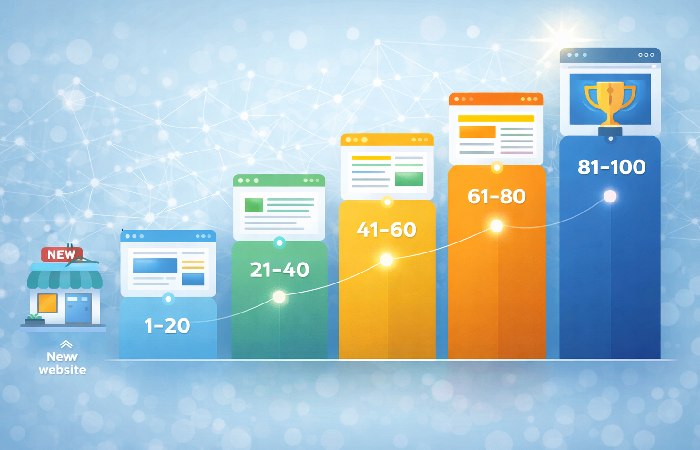
This is the question that trips up most people. The answer: it depends entirely on context.
Industry Benchmarks and Context
Domain Authority is a relative metric, not an absolute one. There’s no universal “good” score because what matters is how your DA compares to your direct competitors in search results.
Here’s a general framework for context:
| DA Range | Typical Site Types | Competitive Context |
|---|---|---|
| 1-20 | Brand new websites, small local businesses | Building foundational authority |
| 21-40 | Established small businesses, niche blogs | Competitive in local/niche searches |
| 41-60 | Regional authorities, growing media sites | Strong presence in specialized topics |
| 61-80 | National brands, major publications | Highly competitive, established authority |
| 81-100 | Tech giants, major media (Google, NYTimes) | Near impossible to reach; elite sites only |
A local plumbing company with DA 25 might dominate its market, while a national news site with DA 65 would struggle to compete. Context is everything.
How to Interpret Your DA Score
Follow this three-step interpretation framework:
- Identify your SERP competitors – Look at who actually ranks for your target keywords (not just similar businesses).
- Check their DA scores – Use a tool like Moz Link Explorer or MozBar to see competitor scores.
- Compare relative positioning – If your DA is 35 and competitors ranking above you have 45-60, that gap indicates link building opportunity. If you’re at 45 and they’re at 42-48, DA isn’t your ranking bottleneck.
The goal isn’t to reach DA 70 arbitrarily. The goal is to match or exceed the DA of sites ranking where you want to rank.
Domain Authority vs Domain Rating: Key Differences
If you’ve explored SEO tools, you’ve likely encountered Domain Rating (DR) from Ahrefs alongside Domain Authority. While similar in purpose, they’re distinct metrics with different methodologies. Both are third-party attempts to model aspects of how search engines evaluate link authority, much like the concept explored in the original PageRank research by Brin and Page at Stanford, but neither is directly used by Google’s current ranking systems.
| Feature | Domain Authority (Moz) | Domain Rating (Ahrefs) | Citation/Trust Flow (Majestic) |
|---|---|---|---|
| Scale | 1-100 (logarithmic) | 0-100 (logarithmic) | 0-100 (separate metrics) |
| Primary focus | Link profile + ML prediction | Backlink quantity and quality | Link trust vs link volume (Citation vs TF) |
| Calculation | 40+ factors, machine learning | Primarily backlink-based | Separate scores for volume vs trust |
| Update frequency | Moz index crawls (varies) | Ahrefs index updates (frequent) | Majestic Fresh Index (updated frequently) |
| Best for | General authority estimation | Backlink-focused analysis | Separating link quality from quantity |
Domain Authority vs Page Authority vs Domain Rating vs Authority Score
DA isn’t the only authority metric. Understanding how it compares to alternatives helps you choose the right tool for the right job.
| Feature | Moz DA | Moz Page Authority (PA) | Ahrefs Domain Rating (DR) | Semrush Authority Score (AS) |
|---|---|---|---|---|
| Scope | Entire domain | Single page | Entire domain | Entire domain |
| Scale | 1-100 | 1-100 | 0-100 | 0-100 |
| Primary factor | Linking root domains | Page-level link profile | Backlink profile strength | Backlinks + traffic + spam signals |
| Data source | Moz Link Explorer | Moz Link Explorer | Ahrefs crawler | Semrush crawler |
| Free access | Yes (limited) | Yes (limited) | Limited (paid for full) | Limited (paid for full) |
| Best for | Competitive benchmarking | Page-level comparison | Link profile analysis | Holistic authority view |
When to Use Which Metric
Use Domain Authority when:
- You’re already using Moz tools and want integrated metrics
- You need a general-purpose authority estimate
- You’re conducting competitive analysis across multiple sites
Use Domain Rating when:
- You’re focused heavily on backlink analysis
- You need more frequent index updates
- You prefer Ahrefs’ larger link index
Use both when:
- You want a more complete picture (they often correlate but can diverge)
- You’re making high-stakes link prospecting decisions
- You’re auditing enterprise-level sites
The metrics generally correlate—a site with high DA usually has high DR—but discrepancies can reveal insights about link profile differences or index coverage.
How to Check Your Domain Authority
Checking your Domain Authority is straightforward with several free and paid tools.
Free DA Checker Tools
- Moz Link Explorer (Free version) – Visit Moz’s Link Explorer, enter your domain, and view your DA along with basic link metrics. The free version limits queries but provides accurate scores.
- MozBar browser extension – Install this Chrome/Firefox extension to see DA and PA scores directly in Google search results as you browse. Useful for quick competitive analysis.
- Third-party DA checkers – Many SEO tools offer free DA lookups, though they ultimately pull data from Moz’s API. Examples include Ahrefs’ free tools, Semrush, and various standalone checkers.
Understanding Your DA Report
When you check your Domain Authority, pay attention to these related metrics for fuller context:
- Page Authority (PA) – A page-level equivalent of DA (1-100 scale) for specific URLs.
- Spam Score – Moz’s estimate of how spammy your site appears (0-17% scale). High spam scores can suppress DA.
- Linking Root Domains – The number of unique websites linking to you. This is one of the strongest DA influences.
- Total Backlinks – Overall link count, though quality matters more than quantity.
These contextual metrics help you understand not just your score, but what’s driving it and where improvement opportunities exist.
How to Improve Your Domain Authority

Improving Domain Authority is a byproduct of building a stronger overall SEO foundation. There are no shortcuts or “DA hacks”—the strategies that improve DA are the same strategies that improve actual Google rankings.
Build High-Quality Backlinks
Since DA is primarily link-based, earning authoritative backlinks is the most direct way to increase your score.
Focus on relevance and authority – A single link from a high-DR industry publication is worth more than dozens from low-quality directories.
- Diversify your link sources – Links from 50 different domains beat 500 links from 10 domains.
- Earn editorial links naturally – Create original research, comprehensive guides, or valuable tools that naturally attract links.
- Guest posting strategically – Contribute expert content to reputable sites in your niche, earning contextual backlinks.
- Digital PR and media outreach – Secure coverage in industry publications, news sites, and authoritative blogs.
Avoid buying links or participating in link schemes. While these might temporarily boost DA, they violate Google’s guidelines and can result in penalties that hurt your actual rankings.
Improve Your Internal Linking Structure
How you distribute link equity within your site affects both DA and individual page rankings.
- Link to important pages more frequently – Pages you want to rank should receive more internal links from relevant content.
- Use descriptive anchor text – Help search engines understand page context through natural, keyword-rich anchors.
- Fix broken internal links – Dead links waste link equity and create poor user experience.
- Create content hubs – Organize related content with strategic internal linking to build topical authority.
Remove or Disavow Toxic Backlinks
Low-quality or spammy backlinks can suppress your Domain Authority and harm your Google rankings.
- Conduct a backlink audit – Use Moz Link Explorer, Ahrefs, or Semrush to identify potentially harmful links.
- Identify toxic link patterns – Look for links from spam sites, link farms, irrelevant foreign sites, or known bad neighborhoods.
- Request removal first – Contact webmasters to remove harmful links before resorting to disavowal.
- Use Google’s Disavow Tool carefully – As a last resort, submit a disavow file to Google (this doesn’t directly affect DA but protects your Google rankings).
Create Link-Worthy Content
The most sustainable link building strategy is creating content so valuable that people naturally want to reference it.
- Original research and data – Conduct surveys, analyze industry trends, or publish proprietary data that others will cite.
- Comprehensive resource guides – In-depth tutorials and guides become go-to references that accumulate links over time.
- Visual content and infographics – Data visualizations and compelling graphics often get shared and linked.
- Tools and calculators – Interactive resources provide unique value and attract natural backlinks.
Improve Your Overall SEO Foundation
Domain Authority reflects your overall site strength, so general SEO improvements indirectly boost DA.
- Technical SEO fundamentals – Ensure your site is crawlable, fast, mobile-friendly, and secure (HTTPS).
- Content quality and depth – Publish authoritative, well-researched content that satisfies search intent.
- User experience signals – Improve site navigation, reduce bounce rates, and enhance engagement metrics.
- Build brand mentions – Even unlinked brand mentions can correlate with authority signals.
Realistic Timeline: How Long to See Results
Realistic Timeline: How Long to See Results
| Current DA | Target DA | Estimated Time |
|---|---|---|
| 1-10 | 20-30 | 3-6 months |
| 20-30 | 40-50 | 6-12 months |
| 40-50 | 55-65 | 9-18 months |
| 60+ | 70+ | 12-24+ months |
DA improvement is not linear. Early gains come faster because of the logarithmic scale. Above DA 60, each point requires significantly more effort, higher‑quality links, and consistent content output.
Common Mistakes and Misconceptions About Domain Authority
Avoid these widespread DA misunderstandings that lead to wasted effort:
- Treating DA as a Google ranking factor – Google does not use Domain Authority in its algorithm. DA correlates with ranking ability but doesn’t cause it.
- Obsessing over DA instead of business outcomes – A DA increase means nothing if traffic, leads, and revenue don’t improve. Focus on metrics that matter to your business.
- Buying links to artificially inflate DA – Purchased links violate Google’s guidelines and create long-term ranking risks despite short-term DA gains.
- Ignoring niche context and competitor comparison – A “low” DA score might be perfectly competitive in your specific market. Always compare to SERP competitors, not absolute standards.
- Panicking over natural DA fluctuations – Minor score changes (±3 points) are normal and often reflect Moz index updates or competitor changes rather than real authority loss.
- Expecting immediate results – Building Domain Authority takes months or years of consistent effort. There are no overnight solutions.
- Using DA for keyword-specific ranking predictions – DA is a domain-level metric. It can’t predict whether a specific page will rank for a specific keyword.
Why Your DA Score Fluctuates (And When to Worry)
Domain Authority scores aren’t static. Understanding normal fluctuations versus concerning drops helps you respond appropriately.
Normal Fluctuation Causes
- Moz index updates – When Moz recrawls the web and updates its index, DA scores across all sites can shift. This doesn’t reflect changes to your site—just updated data.
- Competitor link growth – Since DA is relative, when competitors earn strong backlinks, your comparative score might drop even if your link profile improved.
- Your own link profile changes – Gaining quality links increases DA; losing links (through removed pages or lost partnerships) can decrease it.
- Algorithm adjustments – Moz periodically refines its DA calculation model, which can cause score shifts across the board.
Minor fluctuations of 2-3 points are completely normal and don’t indicate problems. Focus on long-term trends over months, not week-to-week changes.
When a DA Drop Is Concerning
Sudden large decreases (10+ points) – This might indicate a significant loss of backlinks, a penalty, or toxic link issues.
- DA drop correlating with traffic loss – If your DA decreases alongside declining organic traffic and rankings, investigate potential Google penalties or technical issues.
- Steady downward trend over 3-6 months – Gradual but consistent decline suggests competitors are outpacing your link building efforts.
If you experience concerning drops, conduct a thorough backlink audit, check Google Search Console for penalty notifications, and review recent link building activities.
Domain Authority Limitations You Should Know
Domain Authority is useful but imperfect. Understanding its limitations prevents misuse:
- Not a Google ranking factor – Worth repeating: Google’s algorithm doesn’t see or use your DA score. It’s Moz’s interpretation of ranking signals, not the signals themselves.
- Can’t predict ranking for specific keywords – DA is a domain-level metric. A high DA doesn’t guarantee that every page will rank, especially for competitive keywords outside your topical authority.
- Industry and niche differences matter – Different industries have different DA baselines. Legal sites, health sites, and media sites typically have higher DA ranges than local service businesses.
- Gaming the metric doesn’t improve real rankings – You can manipulate DA through tactics that don’t help Google rankings (like low-quality link volume). Always prioritize Google’s perspective over third-party metrics.
- Doesn’t account for content quality or user signals – DA focuses heavily on links. A site with mediocre content but strong links might have high DA while providing poor user experience.
- Tool-dependent variations – Different DA checker tools sometimes show slightly different scores depending on their data freshness and API access.
Who Should Care About Domain Authority (And Who Shouldn’t)
Domain Authority serves specific purposes for certain audiences but isn’t universally important.
Best for:
- SEO professionals conducting competitive analysis – DA provides a quick snapshot for comparing site authority across competitors and identifying link building gaps.
- Link prospecting and outreach prioritization – When evaluating potential link opportunities, DA helps identify which sites offer the most authority value.
- High-level website authority benchmarking – Tracking DA trends over time (quarterly or annually) can indicate whether your authority-building efforts are working.
- Portfolio site evaluation – For agencies or investors managing multiple properties, DA offers standardized comparison across different sites.
Not for:
- Using as your primary SEO KPI – Track traffic, rankings for target keywords, conversions, and revenue instead. DA is a lagging indicator, not a goal.
- Ranking guarantees or predictions – High DA doesn’t guarantee rankings, and low DA doesn’t preclude them. Focus on search intent and content quality.
- Replacement for traffic or revenue metrics – You can’t pay bills with a higher DA score. Business outcomes matter more than arbitrary metrics.
- Micro-managing week-to-week changes – Small fluctuations are meaningless noise. Evaluate trends over months, not days.
Final Verdict: How to Use Domain Authority Wisely
Domain Authority is one useful indicator among many in your SEO toolkit. Use it strategically, but don’t obsess over it.
The smart approach:
Check DA periodically (quarterly) to track long-term authority trends, not daily or weekly.
Compare your DA to direct SERP competitors for the keywords that matter to your business.
Focus your efforts on the fundamentals that improve both DA and actual rankings—quality content, strategic link building, technical excellence, and user experience.
Treat DA increases as a byproduct of good SEO, not the goal itself.
When you’re tempted to chase a higher DA score, ask yourself: “Will this effort also improve my Google rankings, traffic, and business results?” If the answer is no, redirect that energy toward strategies that deliver real outcomes.
Domain Authority measures what you’ve built, but it doesn’t build anything itself. Build for users and search engines, and the scores will follow.
Frequently Asked Questions
Is Domain Authority a Google ranking factor?
No. Domain Authority is a third-party metric created by Moz and is not used by Google’s ranking algorithm. Google has confirmed through official channels that it doesn’t use DA, DR, or similar metrics. However, DA correlates with ranking ability because it measures factors (like quality backlinks) that Google does value.
What is a good Domain Authority score?
There’s no universal “good” score because DA is relative to your competitors and industry. A local business with DA 30 might dominate its niche, while a national brand with DA 60 struggles in competitive verticals. Compare your DA to sites ranking for your target keywords, not to arbitrary benchmarks.
How often does Domain Authority update?
DA updates whenever Moz recrawls your site and updates its index, which varies by site. Moz doesn’t maintain a fixed schedule, so DA might update anywhere from weekly to monthly depending on crawl prioritization. Major algorithm changes from Moz can also trigger widespread DA updates across all sites.
Can Domain Authority decrease?
Yes. DA can decrease due to several factors: losing backlinks (when sites remove your links or go offline), competitors gaining stronger links that change relative comparisons, Moz algorithm updates that reweight factors, or gaining low-quality/spammy links that trigger negative signals.
What’s the difference between Domain Authority and Page Authority?
Domain Authority (DA) measures the ranking potential of an entire domain (like example.com), while Page Authority (PA) measures the ranking potential of a single page (like example.com/specific-page). Both use a 1-100 scale and similar calculation methods. A page’s PA can exceed its domain’s DA if that page has exceptionally strong individual backlinks.
How long does it take to improve Domain Authority?
Improving DA typically takes 3-6 months of consistent effort for noticeable results, though timelines vary widely. Moving from DA 10 to 20 might take a few months with strategic link building, while moving from 60 to 70 could take a year or more. The logarithmic scale means improvement slows as scores increase.
About Technologyies
Technologyies publishes practical, easy-to-understand content on health, technology, business, marketing, and lifestyle. Articles are based mainly on reputable, publicly available information, with AI tools used only to help research, organise, and explain topics more clearly so the focus stays on real‑world usefulness rather than jargon or unnecessary complexity.