



How does Digital Transformation work in Companies?
The harsh reality of digital transformation? Seven out of ten initiatives fail to achieve their goals—wasting billions in investment and eroding stakeholder confidence. Yet the 30% that succeed don’t just survive market disruption; they dominate their industries, outpacing competitors in revenue growth, operational efficiency, and customer satisfaction.
The difference isn’t luck or budget size—it’s strategic execution grounded in realistic expectations, careful prioritization, and unwavering leadership commitment, a pattern consistently highlighted in McKinsey’s research on digital transformations.
This guide cuts through the hype to deliver actionable frameworks, honest risk assessments, and decision-ready insights for business leaders, IT directors, and transformation teams navigating one of the most consequential shifts in modern enterprise history.
Table of Contents
Key Takeaways
- What it is: Digital transformation integrates cloud, AI, and data analytics across all business functions to fundamentally rewire how companies operate and compete—not just automate existing processes.
- Why it matters: Companies that successfully transform achieve 20-30% operational cost reductions, 2-3x faster time-to-market, and measurably higher customer lifetime value within 24-36 months.
- Realistic timeline: Pilot projects show results in 6-18 months; enterprise-wide transformation takes 3-7 years of sustained effort with quarterly milestones.
- Budget reality: Expect 3-10% of annual revenue over multi-year periods; mid-market companies typically invest 500K−5M, enterprises 10M−100M+.
- Success factors: CEO sponsorship, cross-functional governance, change management rigor, and phased execution beat “big bang” approaches by 4x in success rates.
These success patterns closely align with what McKinsey and other global consultancies observe in the minority of digital transformations that actually achieve their business goals.
What Is Digital Transformation?
Digital transformation is the strategic integration of digital technologies—including cloud computing, artificial intelligence, IoT, and advanced analytics—across all areas of a business to fundamentally change how it operates and delivers value to customers. This goes far beyond swapping paper for PDFs or moving files to the cloud.
Leading institutions such as the World Economic Forum describe digital transformation as a fundamental rewiring of how organizations create value and compete, not just a technology upgrade.
True transformation requires rethinking business models (how you create and capture value), operational processes (how work gets done), and organizational culture (how people collaborate and innovate). According to McKinsey’s research on digital rewiring, successful transformations create value by deploying technology at scale while building the capabilities that allow continuous evolution.
What Digital Transformation Is NOT
It’s critical to distinguish three related but distinct concepts:
Digitization: Converting analog information to digital format (scanning documents, digitizing photos). This is a basic prerequisite, not transformation.
Digitalization: Using digital tools to improve existing processes (email replacing memos, CRM software tracking sales). This enhances efficiency but doesn’t fundamentally change the business.
Digital Transformation: Completely reimagining business models, customer experiences, and value creation through technology (Netflix disrupting video rental, Tesla reinventing automotive manufacturing and sales). This creates competitive differentiation and enables entirely new revenue streams.
Key characteristics that define true transformation:
- Enterprise-wide scope affecting multiple functions, not isolated IT projects
- Cultural shift toward data-driven decision making and continuous experimentation
- Customer-centric redesign of experiences across all touchpoints
- Platform-based architecture enabling rapid integration of new capabilities
- Measurable business outcomes tied to strategic objectives, not just technology metrics
Why Digital Transformation Matters in 2026
Digital transformation has evolved from competitive advantage to competitive necessity. Global spending on digital transformation technologies and services is projected to reach $4 trillion by 2027, reflecting the existential pressure companies face to modernize or risk obsolescence.
Global forums and advisory bodies now frame digital transformation as a board-level priority for long-term competitiveness, not an optional IT project, as emphasized by the World Economic Forum.
Operational Efficiency
Cloud infrastructure and automation eliminate manual bottlenecks and legacy system limitations. Companies transitioning from on-premise data centers to cloud platforms typically achieve:
- 15-25% infrastructure cost reduction over three years
- 40-60% faster deployment of new applications and updates
- Near-zero downtime through distributed, resilient architectures
Robotic process automation (RPA) handles repetitive tasks—invoice processing, data entry, compliance reporting—at scale. One multinational bank automated 78% of back-office processes, freeing 2,500 employees to focus on customer service and strategic analysis.
Customer Experience Enhancement
Modern customers expect personalized, omnichannel experiences with instant access across web, mobile, in-store, and voice interfaces. Digital transformation enables:
- Real-time personalization using AI to tailor product recommendations, content, and pricing based on behavior, preferences, and context
- Seamless channel switching allowing customers to start transactions on mobile and complete in-store without friction
- Predictive service anticipating needs before customers articulate them (proactive equipment maintenance, automatic reordering)
Retailers using AI-powered recommendation engines see 10-30% increases in conversion rates and higher average order values. Healthcare providers offering telehealth options report 40-50% improvements in patient satisfaction scores and dramatic reductions in no-show rates.
Data-Driven Decision Making
Legacy systems trap data in siloed databases inaccessible to decision-makers. Cloud-based analytics platforms democratize access to real-time insights:
- Predictive analytics forecast demand, optimize inventory, and identify emerging market trends weeks or months ahead of competitors
- Scenario modeling allows leadership to simulate “what if” scenarios (supply chain disruptions, pricing changes, market entries) with data-backed projections
- Automated reporting replaces manual spreadsheet wrangling, reducing financial close cycles from weeks to days
Manufacturing companies implementing IoT sensors and analytics platforms reduce equipment downtime by 30-50% through predictive maintenance, saving millions in lost production and emergency repairs.
Business Model Innovation
The most transformative outcomes involve entirely new revenue streams impossible without digital capabilities:
- Subscription models replacing one-time transactions (software-as-a-service, equipment-as-a-service)
- Platform ecosystems connecting third-party providers and customers (marketplaces, API partnerships)
- Data monetization selling insights derived from operational data to partners or industry peers
- Outcome-based pricing charging based on results delivered rather than products sold
Industrial equipment manufacturers are evolving from selling machines to offering performance guarantees backed by real-time monitoring and AI-driven optimization—capturing 5-10x higher lifetime customer value.
ROI Expectations: The Reality Check
Digital transformation follows a J-curve pattern: initial investments in infrastructure, talent, and change management create negative cash flow for 12-18 months before value accelerates. Realistic expectations by timeline:
6-12 months: Pilot projects demonstrate proof-of-concept; early wins in specific functions (sales automation, supply chain visibility).
18-24 months: Initial ROI from scaled initiatives; operational efficiency gains become measurable; customer satisfaction metrics improve.
24-36 months: Compounding returns as platforms mature; new revenue streams launch; competitive differentiation becomes evident in market share gains.
3-7 years: Full enterprise transformation with sustained innovation capabilities; cultural shift complete; organization operates as “digital-first” by default.
Companies expecting immediate returns often abandon initiatives prematurely. Those committed to multi-year roadmaps with quarterly milestones capture exponential value over time.
Core Technologies Powering Digital Transformation

Six technology categories form the foundation of modern transformation initiatives. Understanding how each enables specific business outcomes helps prioritize investments.
Cloud Computing
Cloud platforms (Infrastructure-as-a-Service, Platform-as-a-Service, Software-as-a-Service) replace rigid, capital-intensive on-premise data centers with elastic, pay-as-you-go computing resources.
How it enables transformation:
- Scalability: Instantly provision resources for peak demand (holiday shopping, product launches) without overbuilding permanent capacity
- Global reach: Deploy applications in multiple geographic regions with minimal latency
- Cost flexibility: Convert fixed infrastructure costs to variable operating expenses aligned with actual usage
- Rapid innovation: Access cutting-edge capabilities (AI, analytics, IoT) as managed services without building from scratch
Organizations migrating to cloud architectures reduce time-to-market for new features by 50-70% while improving system reliability and disaster recovery capabilities.
Artificial Intelligence & Machine Learning
AI algorithms learn patterns from data to automate decisions, predict outcomes, and personalize experiences at scales impossible for human teams.
How it enables transformation:
- Predictive insights: Forecast customer churn, equipment failures, demand fluctuations with 80-95% accuracy
- Intelligent automation: Handle unstructured tasks (document classification, sentiment analysis, visual inspection) previously requiring human judgment
- Personalization at scale: Tailor content, recommendations, and interactions uniquely for millions of customers simultaneously
- Natural language interfaces: Enable conversational AI for customer service, employee support, and data queries
Financial institutions use machine learning to detect fraudulent transactions in real-time, reducing false positives by 60% while catching 30% more actual fraud than rule-based systems.
Generative AI (large language models, image generation) is rapidly automating content creation, code development, and knowledge synthesis—compressing workflows that took days into minutes.
Data Analytics & Business Intelligence
Modern analytics platforms unify data from disparate sources (ERP, CRM, IoT, external feeds) into centralized, real-time dashboards accessible to stakeholders across the organization.
How it enables transformation:
- Single source of truth: Eliminate conflicting reports and spreadsheet versions; everyone works from identical, current data
- Real-time visibility: Monitor operational metrics (sales, inventory, customer behavior) with minute-by-minute updates
- Advanced analytics: Apply statistical modeling, cohort analysis, and attribution to understand cause-and-effect relationships
- Embedded insights: Surface recommendations directly in operational workflows (next-best-action prompts for sales reps, dynamic pricing suggestions)
Retailers using real-time inventory analytics reduce stockouts by 30-40% while cutting excess inventory holding costs by similar margins.
Internet of Things (IoT)
Connected sensors embedded in equipment, vehicles, facilities, and products generate continuous streams of operational data for monitoring, optimization, and automation.
How it enables transformation:
- Remote monitoring: Track equipment health, environmental conditions, and asset locations without manual inspections
- Predictive maintenance: Identify anomalies (vibration patterns, temperature spikes) signaling impending failures days or weeks in advance
- Process optimization: Adjust manufacturing parameters, climate controls, or logistics routes dynamically based on real-time conditions
- Product innovation: Embed intelligence in products (smart appliances, connected vehicles) enabling new services and revenue models
One industrial manufacturer deployed IoT sensors across its global factory network, achieving $50 million annual savings through energy optimization and unplanned downtime reduction.
Automation & RPA
Robotic process automation uses software bots to execute repetitive, rule-based tasks (data entry, invoice processing, report generation) with perfect consistency and 24/7 availability.
How it enables transformation:
- Eliminate manual work: Free employees from tedious tasks to focus on problem-solving, relationship-building, and innovation
- Reduce errors: Bots execute processes with 99.9%+ accuracy, eliminating costly mistakes from manual data handling
- Accelerate cycles: Complete in minutes what took hours or days (financial close, compliance reporting, customer onboarding)
- Scale without headcount: Handle volume spikes (tax season, enrollment periods) without hiring temporary staff
Insurance companies use RPA for claims processing, reducing cycle times from 7-10 days to under 24 hours while improving customer satisfaction and lowering operating costs.
API-First Architecture
Application Programming Interfaces (APIs) enable different software systems to communicate and exchange data seamlessly, creating the “connective tissue” for integrated digital ecosystems.
How it enables transformation:
- System interoperability: Connect cloud applications, legacy systems, partner platforms, and IoT devices without custom coding
- Faster integration: Launch new capabilities (payment processors, shipping partners, analytics tools) in days instead of months
- Partner ecosystems: Enable third parties to build on your platform or integrate their services into your customer experience
- Flexibility: Swap components (switch CRM vendors, add new channels) without disrupting the entire technology stack
Banks offering API-based services allow fintech partners to embed banking capabilities (payments, lending, account access) into external applications, creating new distribution channels and revenue share opportunities.
Digital Transformation Framework: A Strategic Approach
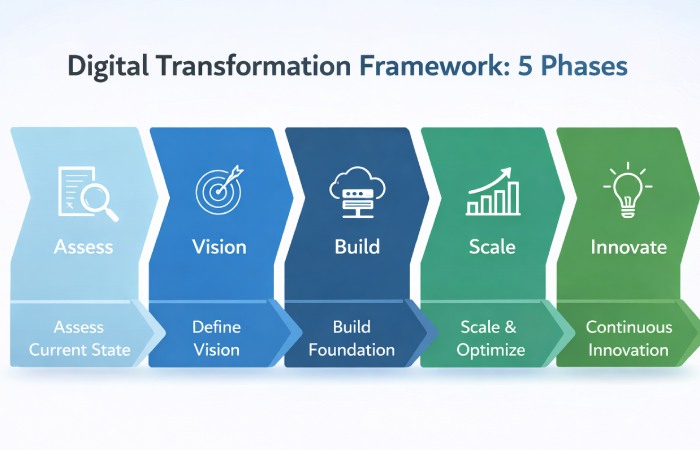
Successful transformations follow a phased roadmap balancing quick wins with long-term capability building. This five-phase framework provides a proven structure.
Phase 1 — Assess Current State
Objective: Establish baseline digital maturity and identify gaps between current capabilities and strategic ambitions.
Key activities:
- Maturity assessment: Evaluate technology infrastructure, data governance, talent capabilities, and cultural readiness across a standardized framework (many consultancies offer maturity models ranging from “digitally nascent” to “digitally advanced”)
- Technology inventory: Catalog existing systems, integrations, data sources, and technical debt
- Process mapping: Document current workflows to identify inefficiencies, bottlenecks, and automation opportunities
- Stakeholder interviews: Gather input from leadership, frontline employees, and customers on pain points and priorities
Outputs: Digital maturity scorecard, prioritized gap analysis, preliminary business case.
Timeline: 4-8 weeks
Phase 2 — Define Vision & Priorities
Objective: Articulate the transformation vision tied to strategic business outcomes and select high-impact pilot projects.
Key activities:
- Vision alignment: Work with C-suite to define 3-5 year ambition (market position, customer experience, operational model)
- Prioritization matrix: Evaluate potential initiatives on impact (revenue, cost, risk reduction) vs. effort (cost, complexity, timeline)
- Pilot selection: Choose 1-3 bounded projects demonstrating value in 6-12 months with manageable risk (single department, specific use case, defined scope)
- Success metrics: Establish KPIs (adoption rates, cycle time reduction, customer satisfaction) with baseline measurements
Outputs: Transformation roadmap, pilot project charters, approved budgets.
Timeline: 6-12 weeks
Phase 3 — Build Foundation
Objective: Establish core infrastructure, data platforms, and governance needed to support scaled initiatives.
Key activities:
- Cloud migration: Move priority applications and data to cloud platforms, starting with non-critical workloads to build competence
- Data integration: Implement centralized data warehouse or lake unifying siloed sources with quality controls
- Security hardening: Deploy identity management, encryption, monitoring, and compliance frameworks appropriate for cloud environments
- Talent acquisition: Hire or upskill teams in cloud architecture, data science, DevOps, and change management
- Governance establishment: Create cross-functional steering committees, decision rights, and funding processes
Outputs: Production cloud environment, integrated data platform, security controls, trained teams.
Timeline: 6-18 months (overlaps with pilot execution)
Phase 4 — Scale & Optimize
Objective: Expand successful pilots across the enterprise, integrate capabilities, and optimize performance.
Key activities:
- Rollout expansion: Deploy proven solutions to additional departments, geographies, or customer segments with lessons learned incorporated
- Integration deepening: Connect systems end-to-end (order-to-cash, procure-to-pay, customer journey across channels)
- Process redesign: Re-engineer workflows to leverage new capabilities rather than automating broken processes
- Change management: Drive adoption through training, incentives, communication, and leadership modeling
Outputs: Enterprise-scale platforms, redesigned operating model, measurable business impact.
Timeline: 12-36 months
Phase 5 — Continuous Innovation
Objective: Embed innovation as ongoing capability through experimentation, feedback loops, and emerging technology adoption.
Key activities:
- Innovation programs: Establish hackathons, innovation labs, or venture funds exploring emerging use cases
- Feedback loops: Collect customer, employee, and operational data to identify improvement opportunities
- Technology monitoring: Track emerging capabilities (generative AI, quantum computing, augmented reality) for strategic relevance
- Cultural reinforcement: Celebrate experimentation, reward calculated risk-taking, and learn publicly from failures
Outputs: Self-sustaining innovation culture, continuous capability enhancement.
Timeline: Ongoing
Digital Maturity Stages: Comparison
| Stage | Characteristics | Key Technologies | Typical Timeline |
|---|---|---|---|
| Digitization | Paper-to-digital conversion; basic automation | Document scanning, email, spreadsheets | 6-12 months |
| Digitalization | Process improvement with digital tools | CRM, ERP, basic analytics | 12-24 months |
| Digital Transformation | Business model reinvention; data-driven culture | Cloud, AI, IoT, advanced analytics | 3-7 years |
| Digital-Native | Technology-first mindset; continuous innovation | Platform ecosystems, real-time decisioning | Ongoing evolution |
Real-World Digital Transformation Examples

Examining specific implementations across industries reveals the technologies, timelines, and outcomes achieved by successful transformation initiatives.
Retail — Omnichannel & Personalization
IKEA’s Digital Reinvention:
IKEA, the global furniture retailer, embarked on transformation to compete with e-commerce pure-plays and evolving customer expectations. Key initiatives included:
Technologies deployed:
- Augmented reality (AR): IKEA Place app allows customers to visualize furniture in their homes using smartphone cameras, reducing purchase hesitation and return rates
- Service integration: Acquisition of TaskRabbit embedded assembly services into the purchase journey, converting friction points into revenue opportunities
- Inventory optimization: Real-time stock visibility across warehouses and stores enables accurate availability promises and efficient order fulfillment
Outcomes:
- Double-digit e-commerce growth year-over-year
- Reduced showroom dependency by enabling confident online purchases
- Higher customer lifetime value through service attachment
Helzberg Diamonds’ AI Implementation:
After more than a century in business, the jewelry retailer implemented AI-driven demand forecasting and assortment planning to compete with online disruptors.
Technologies deployed:
- Machine learning models analyzing historical sales, seasonality, trends, and local demographics
- Automated replenishment triggering inventory orders based on predictive demand
- Assortment optimization tailoring store-level product mix to local customer preferences
Outcomes:
- 20% reduction in stockouts for high-demand items
- 15% decrease in excess inventory holding costs
- Improved margins through better buying decisions
Healthcare — Telehealth & EHR Optimization
King’s College Hospital London (Dubai) Digital Health Record:
The hospital modernized its electronic health record (EHR) infrastructure on Oracle Cloud Infrastructure to improve clinician productivity and patient care quality.
Technologies deployed:
- Cloud-based EHR replacing on-premise systems with performance bottlenecks
- Optimized database architecture for faster queries and transaction processing
- Integrated clinical workflows connecting diagnostics, pharmacy, and billing
Outcomes:
- 50% reduction in patient information access time
- 25% overall EHR time savings through faster screen loads and response
- Improved care coordination via real-time data availability across departments
Telehealth Expansion Across Providers:
Healthcare organizations rapidly scaled virtual visit capabilities, driven initially by pandemic necessity but sustained by patient preference and economic advantages.
Technologies deployed:
- Video consultation platforms integrated with EHR and scheduling systems
- Remote patient monitoring using connected devices (blood pressure cuffs, glucose monitors)
- AI-powered triage routing patients to appropriate care levels based on symptom assessment
Outcomes:
- 40-50% patient satisfaction improvements due to convenience and reduced wait times
- 30% reduction in no-show rates compared to in-person appointments
- Cost savings from facility utilization optimization and expanded provider capacity
Manufacturing — Industry 4.0 & Predictive Maintenance
Smart Factory Implementations:
Leading manufacturers deploy IoT sensors, robotics, and AI across production lines to achieve unprecedented efficiency and quality.
Technologies deployed:
- IoT sensor networks monitoring equipment vibration, temperature, pressure, and output quality
- Digital twins creating virtual replicas of physical assets for simulation and optimization
- Machine vision using cameras and AI to detect defects invisible to human inspectors
- Collaborative robots (cobots) working alongside humans on assembly tasks
Outcomes:
- 30-50% reduction in unplanned downtime through predictive maintenance alerts
- Quality improvements with defect detection rates exceeding 99%
- Energy savings of 10-20% through optimized equipment operation
One global manufacturer achieved $50 million annual savings from IoT-driven energy management and maintenance optimization alone.
Financial Services — API Banking & Customer Portals
Open Banking Platforms:
Banks are transforming from closed systems to open platforms enabling third-party developers to build integrated financial services.
Technologies deployed:
- RESTful API infrastructure exposing core banking functions (account access, payments, lending)
- Developer portals with documentation, sandbox environments, and partnership management
- Real-time payment rails enabling instant transfers and settlements
- Advanced authentication using biometrics and behavioral analytics
Outcomes:
- New distribution channels through fintech partnerships reaching underserved segments
- Revenue share models from transaction fees on third-party services
- Enhanced customer experience with embedded finance in e-commerce, gig platforms, and mobility apps
- Faster innovation as external developers create use cases internal teams wouldn’t prioritize
One regional bank reported 40% of new account openings originating from API-enabled partner channels within two years of platform launch.
Common Digital Transformation Challenges (And How to Overcome Them)
Understanding obstacles ahead allows proactive mitigation. These five challenges derail more initiatives than technology failures.
Recent surveys from Gartner show that fewer than half of digital initiatives fully meet or exceed their business outcome targets, underscoring how easy it is to fall short without disciplined execution.
Cultural Resistance & Change Management
The challenge:
Employees comfortable with existing processes resist new tools, fearing job displacement, increased workload during transition, or irrelevance of hard-won expertise. Middle managers protect turf against cross-functional teams. Executives demand ROI before investing in enablers like training.
Research shows cultural resistance accounts for 30-40% of transformation failures—more than technology issues.
This mirrors findings from McKinsey’s analysis of large-scale transformations, which consistently points to culture and leadership as primary failure points.
How to overcome it:
- Leadership modeling: C-suite must visibly adopt new tools and behaviors, demonstrating commitment beyond mandate
- Transparent communication: Share the “why” repeatedly—competitive threats, customer expectations, market opportunities—connecting transformation to organizational survival
- Involve employees early: Co-create solutions with frontline teams who understand process realities; their input improves designs and builds ownership
- Celebrate early wins: Publicize quick wins demonstrating tangible benefits (time saved, customer satisfaction improvements) to build momentum
- Provide comprehensive training: Invest in skills development, not just tool tutorials; address anxiety through gradual competence building
- Address job security fears directly: Clarify automation’s role in eliminating tedious work while creating higher-value opportunities; offer reskilling pathways
Organizations treating change management as core workstream (not an afterthought) achieve 4x higher adoption rates and faster time-to-value.
Legacy System Integration
The challenge:
Decades-old mainframe systems, custom-coded applications, and undocumented integrations create technical debt that’s expensive to replace and risky to maintain. Modern cloud platforms can’t easily connect with legacy architectures. Data trapped in old systems becomes inaccessible for analytics.
How to overcome it:
- Incremental approach: Prioritize “strangler pattern” strategies that gradually replace legacy components rather than risky “big bang” migrations
- API wrapper layers: Build middleware exposing legacy system data and functions through modern APIs without full replacement
- Phased retirement: Move lower-risk, lower-complexity workloads first to build competence before tackling mission-critical systems
- Parallel operation: Run old and new systems simultaneously during transition with reconciliation processes until confidence is established
- Vendor partnerships: Engage specialists experienced in specific legacy platforms (AS/400, SAP ECC, Oracle EBS) for migration planning
- Accept coexistence: Recognize some legacy systems may remain operational for years; design integrations allowing modern and legacy to interoperate
Budget 20-30% of transformation spending on integration and migration efforts—underestimating this is a primary cause of budget overruns.
Skills Gaps & Talent Acquisition
The challenge:
Cloud architects, data scientists, AI engineers, DevOps specialists, and cybersecurity experts are scarce and expensive. Internal IT teams skilled in legacy technologies lack cloud-native capabilities. Business units don’t have data literacy to leverage new analytics tools.
How to overcome it:
- Build and buy strategy: Combine selective external hiring for critical gaps with aggressive upskilling of existing teams
- Strategic partnerships: Engage managed service providers or consultancies to supplement capacity during peak periods or provide specialized expertise
- Learning programs: Invest in cloud certifications (AWS, Azure, Google Cloud), data analytics training (SQL, Python, visualization), and change management skills for broader organization
- Talent retention: Competitive compensation, career development opportunities, and meaningful project assignments reduce attrition of newly trained staff
- Democratization tools: Adopt low-code/no-code platforms enabling business users to build applications and analytics without deep technical skills
- University partnerships: Build talent pipelines through internships, sponsored research, and curriculum collaboration
Companies viewing talent as strategic investment (not cost center) consistently outperform peers in transformation outcomes.
Cybersecurity & Data Privacy Risks
The challenge:
Cloud migration expands attack surfaces. API connections create new vulnerabilities. Data integration concentrates risk—one breach exposes consolidated information. Regulatory requirements (GDPR, CCPA, industry-specific mandates) impose steep penalties for non-compliance.
How to overcome it:
- Security-by-design: Embed security architecture decisions from project inception, not as afterthought; conduct threat modeling for each initiative
- Zero-trust principles: Implement identity verification, least-privilege access, and continuous monitoring rather than perimeter-based defenses
- Encryption everywhere: Protect data in transit and at rest; manage encryption keys separately from data storage
- Compliance automation: Use tools that continuously audit configurations against regulatory requirements, flagging deviations in real-time
- Incident response planning: Develop and test breach response procedures; conduct tabletop exercises simulating attacks
- Third-party risk management: Vet cloud providers, SaaS vendors, and integration partners for security practices and compliance certifications
For detailed cybersecurity frameworks applicable to digital transformation initiatives, the U.S. National Institute of Standards and Technology (NIST) provides comprehensive guidance through its Cybersecurity Framework and cloud security publications.
Budget 10-15% of transformation spending on security controls and compliance measures—the cost of prevention is far lower than breach remediation and regulatory fines.
Budget Overruns & ROI Pressure
The challenge:
Initial estimates undercount integration complexity, data migration effort, and change management needs. Scope creep adds requirements mid-stream. Business cases assume optimistic adoption and value realization. Leadership loses patience when results lag projections.
How to overcome it:
- Phased funding: Allocate budgets by phase (pilot, scale, optimize) with gate reviews validating value before releasing next tranche
- Contingency reserves: Build 20-30% contingency into budgets for unforeseen challenges; releasing unused reserves builds credibility
- Rigorous business cases: Use conservative assumptions; separate “must-have” from “nice-to-have” benefits; validate with external benchmarks
- Quarterly value tracking: Measure and report KPIs frequently; course-correct initiatives underperforming expectations
- Scope discipline: Establish formal change control processes; resist feature additions without corresponding timeline/budget adjustments
- Transparent communication: Report setbacks and learnings to stakeholders promptly; surprises erode trust and support
Transformations with disciplined financial governance achieve ROI targets 3x more frequently than those lacking formal tracking and accountability.
Who Should Pursue Digital Transformation (And Who Should Wait)
Digital transformation isn’t universally applicable or equally beneficial across all organizations. Honest assessment of readiness prevents costly false starts.
Best for:
Mid-to-large enterprises ($50M+ annual revenue):
- Sufficient scale to justify multi-million dollar investments
- Complexity requiring technology-enabled coordination
- Established processes ready for optimization (not startups still defining workflows)
Companies with mature foundational processes:
- Documented workflows providing baseline for improvement
- Basic data hygiene (customer records, financial systems, inventory tracking)
- Operational stability allowing focus on transformation vs. firefighting
Industries facing digital disruption:
- Retail: E-commerce and omnichannel competition
- Financial services: Fintech challengers and regulatory pressure for modernization
- Healthcare: Consumerization and value-based care models
- Manufacturing: Industry 4.0 and supply chain resilience imperatives
- Insurance: Telematics, embedded coverage, and automated underwriting
Organizations with committed C-suite leadership:
- CEO personally championing transformation as strategic priority
- Board-level support for multi-year investment horizons
- Willingness to make difficult organizational changes (structure, incentives, talent)
Cultural indicators of readiness:
- History of successfully executing complex change initiatives
- Data-driven decision making already valued (even if tools are basic)
- Customer-centric orientation prioritizing experience over internal convenience
Proceed with Caution If:
Financial instability or constrained cash flow:
- Transformation requires sustained investment before returns materialize
- Cost-cutting pressures may force premature initiative cancellation
- Better to stabilize finances through operational improvements before major technology bets
Leadership turnover or organizational uncertainty:
- CEO transitions often reset strategic priorities
- Mergers/acquisitions create competing demands and integration challenges
- Lack of sponsorship continuity dooms multi-year initiatives
Immature or chaotic existing processes:
- “Paving the cow path” with technology perpetuates dysfunction
- Focus first on process excellence, then technology enablement
- Exception: if transformation explicitly includes process re-engineering with expert support
Severe skills gaps without training/hiring budgets:
- Technology alone doesn’t deliver value—capable people do
- Underfunded transformation teams get overwhelmed and burn out
- Partner support can fill gaps but requires budget allocation
Regulatory or compliance uncertainties:
- Highly regulated industries (healthcare, finance) must ensure solutions meet requirements
- Rushing ahead without legal/compliance review risks expensive rework or penalties
Alternative Approaches:
For small businesses (<$50M revenue) or resource-constrained organizations:
Incremental digitalization rather than transformation:
- Adopt proven SaaS applications addressing specific pain points (CRM, accounting, project management)
- Leverage vendor-managed solutions minimizing internal IT demands
- Focus on measurable quick wins (payment processing, inventory tracking, customer communication)
- Build digital capabilities gradually as revenue and team capacity grow
For organizations in transition:
- Delay major initiatives until leadership stability and strategic clarity emerge
- Use transition periods for planning, skill-building, and pilot experiments
- Position transformation as fresh start under new leadership rather than mid-stream change
How to Start Your Digital Transformation Journey
This six-step sequence provides a practical launch path for organizations ready to begin.
Step 1: Secure Executive Sponsorship
Transformation succeeds or fails based on C-suite commitment. Before launching:
- Gain CEO endorsement as visible champion, not just passive approver
- Align board expectations on multi-year timelines and investment requirements
- Establish executive steering committee with representatives from all major functions (finance, operations, IT, sales, HR)
- Define governance structure clarifying decision rights, escalation paths, and accountability
Without unwavering top-level support, initiatives devolve into fragmented IT projects lacking strategic coherence or organizational commitment.
Step 2: Conduct Readiness Assessment
Use this checklist to evaluate preparedness across critical dimensions:
Technology Readiness:
- Current infrastructure documented (applications, integrations, data flows)
- Cloud strategy defined (public, private, hybrid, multi-cloud)
- Cybersecurity baseline meets industry standards
- Technical debt quantified with remediation plans
Data Readiness:
- Key data sources identified and accessible
- Data quality issues cataloged (duplicates, inconsistencies, gaps)
- Governance framework exists (ownership, policies, standards)
- Analytics use cases prioritized
Organizational Readiness:
- Change management capability or partner identified
- Talent gaps assessed with hiring/training plans
- Incentives and performance metrics aligned to transformation goals
- Communication plan prepared for stakeholder engagement
Financial Readiness:
- Multi-year budget approved covering technology, talent, partners
- Business case validated with conservative ROI projections
- Funding model established (centralized vs. distributed)
- Value tracking mechanisms designed
Gaps identified through assessment become early workstreams addressing foundational needs before scaling.
Step 3: Identify 1-2 High-Impact Pilot Projects
Select bounded initiatives demonstrating value quickly while building organizational capability:
Criteria for pilot selection:
- Clear business outcome: Measurable KPI improvement (cycle time, cost, satisfaction) in 6-12 months
- Manageable scope: Single department, defined use case, limited integrations
- Executive sponsor: Leader with authority and budget willing to champion
- Cross-functional relevance: Learnings applicable to future initiatives
- Technology proof-of-concept: Tests priority capabilities (cloud, AI, analytics) at small scale
Examples of effective pilots:
- Sales automation: AI-powered lead scoring and CRM workflow optimization
- Supply chain visibility: IoT sensors and real-time dashboards for logistics tracking
- Customer service chatbot: Natural language AI handling routine inquiries
- Predictive maintenance: Analytics identifying equipment failure patterns
Resist launching too many pilots simultaneously—focus enables depth over breadth.
Step 4: Build Cross-Functional Transformation Team
Assemble dedicated resources with diverse expertise:
Core team roles:
- Transformation leader (executive-level, reporting to CEO): Owns roadmap, budget, and delivery
- Business architects (2-3): Translate strategy into requirements; design future-state processes
- Technical architects (2-3): Design cloud infrastructure, data platforms, integration architecture
- Data scientists/analysts (1-2): Build predictive models, analytics dashboards
- Change management leads (1-2): Drive adoption through training, communication, stakeholder engagement
- Product managers (1-2 per major initiative): Own specific transformation workstreams end-to-end
Extended team:
- IT specialists (cloud engineers, security, DevOps): Execute technical implementations
- Business unit representatives: Subject matter experts ensuring solutions meet operational needs
- External partners: Consultants, managed service providers, technology vendors for specialized capabilities
Teams structured as permanent capability (not temporary project overlay) sustain transformation momentum beyond initial phases.
Step 5: Set Clear Metrics & Governance
Define how success will be measured and how decisions will be made:
Tiered KPI framework:
Strategic KPIs (reported to board quarterly):
- Revenue growth attributed to digital channels/capabilities
- Customer lifetime value and satisfaction scores
- Operational cost as % of revenue
- Employee engagement and retention
Initiative KPIs (tracked monthly):
- Adoption rates (% of users actively leveraging new tools)
- Process cycle time reductions (order-to-cash, time-to-market)
- Quality improvements (defect rates, accuracy)
- Cost savings vs. baseline
Activity metrics (monitored weekly):
- Cloud migration progress (workloads moved)
- Training completion rates
- Incident resolution times
- Budget variance
Governance mechanisms:
- Weekly transformation team standups: Tactical coordination, blocker removal
- Monthly steering committee reviews: Portfolio health, resource allocation, escalations
- Quarterly business reviews with CEO/board: Strategic alignment, investment decisions, course corrections
Transparency in metrics builds accountability and maintains stakeholder confidence through inevitable challenges.
Step 6: Execute, Measure, Iterate
Launch pilots with disciplined execution practices:
- Agile methodologies: Two-week sprints with working software demos; continuous stakeholder feedback
- Pilot-scale-optimize pattern: Validate in controlled environment; scale proven solutions; optimize based on production learnings
- Retrospectives: Regular team reflection on what’s working and what needs adjustment
- Communication cadence: Weekly updates to stakeholders; celebrate wins; transparently address setbacks
- Value realization tracking: Measure actual benefits vs. business case projections; adjust strategies for underperforming initiatives
Successful pilots become templates for enterprise rollout—codifying technical patterns, change management approaches, and governance models.
Digital Transformation Success Metrics
Measuring transformation progress requires balancing leading indicators (activity and adoption signals) with lagging indicators (business outcome results).
Leading Indicators
These metrics signal progress before financial results materialize:
Adoption metrics:
- % of target users actively logging into new systems weekly
- Transactions processed through new vs. legacy platforms
- Mobile app downloads and daily active users
Operational efficiency:
- Process cycle time reduction (order processing, customer onboarding, financial close)
- Manual touchpoints eliminated per workflow
- Data accessibility (time to retrieve information, report generation speed)
Technical health:
- Application uptime and performance (response times, error rates)
- Cloud migration progress (workloads transitioned, data volume migrated)
- API call volumes (indicating integration usage)
Organizational capability:
- Employees trained and certified in new technologies
- Cross-functional team collaboration scores
- Innovation pipeline (ideas submitted, pilots launched)
Lagging Indicators
These metrics capture ultimate business value:
Financial performance:
- Revenue growth in digital channels or new business models
- Operating cost reduction as % of baseline
- EBITDA improvement attributable to transformation initiatives
- ROI: (Benefits realized – Investment) / Investment
Customer metrics:
- Net Promoter Score (NPS) and customer satisfaction (CSAT) improvements
- Customer lifetime value increase
- Churn/retention rate changes
- Online conversion rate and average order value
Competitive position:
- Market share gains in key segments
- Time-to-market for new products/features vs. competitors
- Brand perception scores on innovation and digital experience
Risk reduction:
- Security incident frequency and severity
- Compliance audit findings
- System downtime hours
- Data quality scores
Metrics Table: Measurement Framework
| Metric | How to Measure | Target Benchmark |
|---|---|---|
| Cloud Adoption Rate | % of workloads migrated to cloud | 70-80% within 24 months |
| Process Cycle Time | Order-to-cash, lead-to-opportunity time | 30-50% reduction in 18 months |
| Customer Satisfaction | NPS survey scores | +10-15 point improvement |
| Automation Coverage | % of processes fully automated | 40-60% of repetitive tasks |
| Employee Productivity | Output per FTE, time saved per week | 15-25% improvement |
| Operating Cost Ratio | Costs as % of revenue | 3-5 percentage point reduction |
| Innovation Velocity | Time from idea to production | 50% faster than baseline |
| Data Accessibility | Time to generate reports/insights | Real-time vs. days/weeks |
Regularly review both leading and lagging indicators to detect early warning signs (low adoption, technical issues) before they impact business outcomes.
The Future of Digital Transformation
As transformation evolves from initiative to ongoing capability, several emerging trends will reshape how organizations compete.
Generative AI at Scale:
Large language models (ChatGPT, Bard, Claude) and generative AI tools are moving from experimental pilots to enterprise production. Applications expanding rapidly:
- Content creation: Marketing copy, product descriptions, training materials generated at scale
- Code development: AI pair-programming accelerating software delivery by 30-50%
- Knowledge synthesis: Automated summarization of documents, meetings, research
- Customer interaction: Highly capable chatbots handling complex service scenarios
Organizations integrating generative AI into core workflows report productivity gains of 20-40% in knowledge work.
Sustainability & ESG Integration:
Digital transformation increasingly serves environmental, social, and governance objectives:
- Carbon tracking: IoT sensors and analytics measuring emissions across supply chains in real-time
- Circular economy models: Product-as-a-service enabled by connected devices and predictive maintenance
- Sustainable operations: AI optimizing energy usage, waste reduction, and resource allocation
- ESG reporting automation: Integrated data platforms streamlining sustainability disclosures
Investors and customers reward companies demonstrating measurable sustainability progress—digital capabilities make transparent reporting possible.
Human-AI Collaboration Models:
Rather than wholesale automation, leading organizations design workflows combining human judgment with AI augmentation:
- Augmented decision-making: AI surfaces insights and recommendations; humans retain final authority
- Intelligent assistants: Tools that handle routine tasks while routing complex cases to specialists
- Continuous learning systems: AI models that improve through human feedback and corrections
This approach addresses workforce concerns while maximizing the strengths of both humans (creativity, empathy, ethics) and AI (speed, scale, pattern recognition).
Edge Computing & 5G:
As IoT devices proliferate and latency-sensitive applications expand (autonomous vehicles, remote surgery, augmented reality), processing moves closer to data sources:
- Edge analytics: Real-time decision-making at device/facility level without cloud round-trips
- 5G connectivity: Ultra-fast, low-latency networks enabling mobile and remote use cases previously impossible
- Distributed intelligence: AI models running on edge devices for privacy-preserving, always-available capabilities
Manufacturing, logistics, and healthcare will see particularly dramatic impacts from edge computing maturity.
Quantum Computing (Long-Term):
While mainstream business applications remain years away, quantum computing promises to revolutionize optimization problems currently unsolvable:
- Supply chain optimization: Route planning and resource allocation at unprecedented scale
- Drug discovery: Molecular simulations accelerating pharmaceutical development
- Financial modeling: Risk analysis and portfolio optimization with exponentially greater complexity
- Cryptography: Both threats (breaking current encryption) and opportunities (quantum-safe security)
Organizations should monitor quantum progress and begin scenario planning for its eventual impact.
Final Verdict: Is Digital Transformation Right for Your Company?
Digital transformation represents one of the most significant strategic commitments an organization can make—comparable to market entry, major M&A, or business model reinvention. The decision requires honest assessment of readiness, resources, and resolve.
Decision Framework:
Pursue full transformation if:
- Annual revenue >$50M with stable financial position
- CEO and board committed to 3-7 year investment horizon
- Industry facing digital disruption threatening current competitive position
- Foundational processes and data infrastructure reasonably mature
- Capability and willingness to invest 3-10% of revenue over multiple years
- Change management competency or ability to hire/partner for it
Pursue phased approach (pilot-then-scale) if:
- Revenue 10M−50M with growth trajectory
- Leadership committed but organizational readiness mixed
- Some digital capabilities in place but fragmented
- Budget constraints requiring proof-of-value before full investment
- Competitive pressure building but not yet existential
Delay or pursue incremental digitalization if:
- Revenue <$10M or financial instability
- Leadership turnover or strategic uncertainty
- Immature processes requiring operational excellence first
- Severe talent gaps without resources to address
- Already digital-native (startups, tech companies)
Key Takeaway:
Digital transformation is not a one-time project but an ongoing evolution of capabilities. Companies that succeed treat it as cultural and strategic shift enabled by technology—not a technology initiative with hoped-for business benefits.
The 30% that achieve their transformation goals share common characteristics: unflinching leadership commitment, disciplined execution with learning mindset, balanced investment across technology and people, and patient capital willing to fund multi-year journeys.
For organizations meeting readiness criteria, the risk of inaction exceeds the risk of imperfect execution. Markets punish hesitation—customers, competitors, and disruptors don’t wait for perfection.
Start with honest assessment. Build on quick wins. Learn continuously. The journey is long, but the destination—a resilient, innovative, customer-centric organization—is worth the commitment.
Frequently Asked Questions
What is digital transformation in simple terms?
Digital transformation is how a company uses technologies like cloud, AI, and data to change how it operates and serves customers. It goes beyond digitizing paperwork or automating tasks and involves rethinking business models, customer journeys, and culture so the organization can adapt continuously.
Why is digital transformation important for companies?
Digital transformation in companies can cut operating costs, speed up product launches, and improve customer satisfaction. Firms that execute well often see 20–30% cost reductions, 2–3x faster time‑to‑market, and new digital revenue streams, which can be the difference between leading a market and being disrupted.
What are real examples of digital transformation?
IKEA uses augmented reality apps so customers can see furniture in their homes, integrates TaskRabbit for assembly, and runs omnichannel inventory. King’s College Hospital in Dubai moved to cloud electronic health records and halved patient information access time. Manufacturers use IoT sensors for predictive maintenance, cutting unplanned downtime by 30–50%.
How long does digital transformation take?
Digital transformation usually starts with pilots that show results in 6–18 months. Scaled initiatives often deliver broader impact in 18–36 months, as adoption grows. Full enterprise transformation, including culture and new ways of working, commonly takes 3–7 years of consistent investment and leadership support.
What are the biggest challenges in digital transformation?
The biggest challenges include cultural resistance, legacy system integration, skills gaps in cloud, data, and AI, growing cybersecurity risks, and budget overruns. Many digital transformation projects fail because companies underestimate integration complexity and change management or expect quick returns from what is really a multi‑year journey.
How much does digital transformation cost?
Digital transformation costs vary by size and scope. Many organizations invest 3–10% of annual revenue over several years. As a rough guide, mid‑market companies may spend around 500K–5M, while large enterprises can allocate 10M–100M+ for full programs, with smaller pilots in the 50K–500K range.
About Technologies
Technologies publishes practical, easy-to-understand content on health, technology, business, marketing, and lifestyle. We rely mainly on reputable, publicly available information, and use AI tools only to help research, organize, and explain topics more clearly so the focus stays on real-world usefulness rather than jargon or unnecessary complexity.
Disclaimer: Content on Technologyies is for general information only and is not professional advice. Always verify information and consult a qualified expert before making important decisions.