
Outsourcing the IT department doesn’t remove the governance problem, it

CBSETak Org Review: Is It Real, Fake, or Just Risky?
Note:Last updated: May 2026
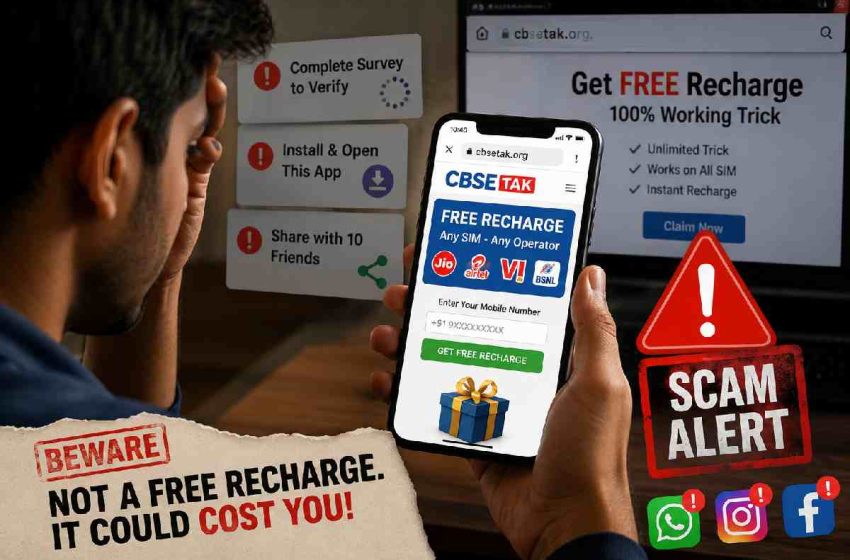
Someone forwarded you a link on WhatsApp. Or maybe you saw a reel on Instagram — “free recharge for any SIM, just enter your number.” The site behind the claim? cbsetak.org. And now you’re here, trying to figure out if it’s worth trusting before you hand over your phone number.
Short answer: it’s not worth the risk.
CBSETak.org is a content driven website, with the free recharge offers and facebook and Instagram password claim being used to attract Indian mobile users. There is no independent confirmation that anyone was actually gifted with a real, long-term mobile recharge. The domain was registered in January 2024 with anonymized registrant information, with no business relationship with an Indian telecom provider, and the name “CBSE” is an acronym for the ‘Central Board of Secondary Education’, and is not related to the online recharge site.
This guide lays out precisely what cbsetak.org is up to, how legitimate sites like it really profit from your visit, how dangerous it is to use it, and what you should do instead – including how to report it if you‘ve already given it your personal details.
Within the 12 months, a handful of Indian tech blogs, YouTube channels, and scam checking websites have assessed the website cbsetak.org and pointed out those three specific issues: offers that have to be verified, a lot of pushy task loops and lack of transparency about what happens with your data.
Table of Contents
Quick Answers
- “Is cbsetak org real?” → The website exists, but its free recharge and password-finding claims are unverified. Multiple user reports and fact-checks flag it as high-risk.
- “Will I get free recharge?” → Almost certainly not. Users report completing tasks endlessly with no recharge delivered.
- “Is it connected to CBSE?” → No. The name borrows the acronym purely for search visibility.
- “Is my data safe on cbsetak?” → There are no guarantees. The site collects phone numbers and may expose you to third-party trackers.
- “What should I do instead?” → Use official telecom apps (Jio, Airtel, Vi) or report the site through India’s National Cyber Crime Reporting Portal.
60‑Second Self‑Check: Are You About to Fall for a Free Recharge Scam?
Ask yourself these three questions before you tap any “free recharge” link:
- Does the page ask for my phone number before showing any real information?
- Am I being pushed to complete multiple tasks (surveys, app installs, referrals) with no clear end?
- Is this offer coming from my operator’s official app or website, or from a random blog I’ve never heard of?
If you answered “yes” to the first two and “no” to the last, treat the offer as unsafe and close the page immediately.
What Is CBSETak Org?
CBSETak.org may be an Indian content website which provides articles on free mobile recharge offers, social media growth hacks and tech hacks. The website is not related in any way with the Central Board of Secondary Education (CBSE) and does not hold any recognized association with any Indian telecom operator. The portal mainly caters to Indian mobile users by way of popular social media content and search engines.
That definition matters. Because the name is doing heavy lifting that the content can’t support.
What the Site Claims to Offer
The site’s articles cover a wide range of topics — free recharge for Jio, Airtel, Vi, and BSNL; “4G to 5G upgrade” tricks; WhatsApp tracking tools; Instagram follower growth; and even accident-related information in Hindi. But the big draw — the reason most people land on cbsetak.org — is the promise that you can enter your mobile number and receive an instant, free recharge.
Some posts also claim the site can help you find someone’s Instagram password. More on that later (spoiler: it can’t).
Is CBSETak Connected to CBSE?
Not at all. The Central Board of Secondary Education is maintained by cbse.gov.in and cbseresults.nic.in both of these sites are hosted by a government domain name. CBSETak.org was purchased from commercial domain name registrar Porkbun in January 2014. The owner of this domain name has concealed his details using WHOIS privacy protection.
So why the name? It’s a search visibility play. Millions of Indian students search for “CBSE” every month during exam season. Borrowing those letters gives the site a traffic boost it hasn’t earned through actual educational content.
Official vs Unofficial Sites at a Glance
| Purpose | Official domain example | What to watch for on look‑alikes |
|---|---|---|
| CBSE information | cbse.gov.in, cbseresults.nic.in | Always a .gov.in or .nic.in address |
| Telecom recharges | jio.com, airtel.in, myvi.in | Direct operator branding and support |
| Unofficial “trick” sites | cbsetak.org and similar blogs | No .gov.in, no operator logo, hidden owners |
Why Is CBSETak Org Trending in India?
You’ve probably seen it because someone shared it — not because you went looking for it.
The site’s traffic pattern tells a clear story. According to third‑party traffic estimation tools, cbsetak.org recorded roughly tens of thousands of visits in a single recent month, with the vast majority of that traffic coming from mobile devices in India. The top search query driving visitors was simply “cbsetak org” — meaning most people were searching for the site by name after encountering it on social media.
That’s how viral content loops work. A WhatsApp forward promises free recharge. You search the site name to check if it’s real. You land on articles that either confirm your suspicion or — on less careful sites — make it sound like the offer might actually work. And the cycle keeps going.
The site’s authority score (17 out of 100, per Semrush) and its 107 referring domains — mostly from low-quality sources — confirm that this is a traffic-volume play, not a trust-building one.
How Does CBSETak Org Actually Work?
Ever wondered how someone could even conceive of creating an entire web-site dedicated solely to giving free recharges? Well this is what‘s really happening under the hood.
The Free Recharge Process (Step by Step)
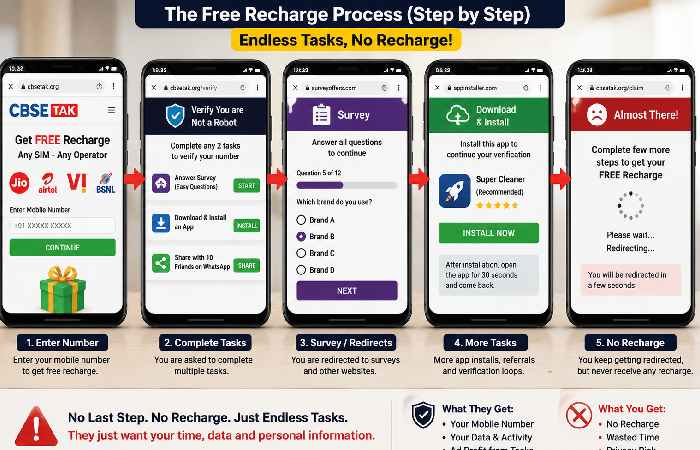
The site walks you through what looks like a simple process:
- Visit cbsetak.org and find a “free recharge” article
- Enter your mobile number and select your telecom operator
- Choose a recharge amount
- Complete “a few simple tasks” — watching ads, filling out surveys, downloading apps, or sharing the link with friends
After step four, you’re supposed to receive your recharge. But that’s where things fall apart. Users consistently report that after completing every task, they’re redirected to more tasks. Then more. And more. No recharge arrives. The process loops until you give up or close the browser.
The Ad-Revenue Model Behind the Site
This is the part no other review of cbsetak.org explains clearly — and it’s the most important piece.
Sites like cbsetak.org don’t make money by giving you recharges. They make money every time you interact with their pages. Each ad you view, each survey you complete, each app you download through their links generates revenue for the site owner through ad networks and affiliate programs. Your phone number? That’s data they can sell or use for targeted SMS campaigns.
Think of it this way. You’re spending 10–15 minutes completing tasks. The site earns ₹5–₹15 per ad impression and survey completion from you. But they never spend a single rupee on your recharge. You’re not the customer here. You’re the inventory.
Is CBSETak Org Real or Fake?
The honest-to-goodness answer is a mix of “fake” and “risky.” The site is in fact real, it does exist, it does load and it does produce content. But the claims it puts on demand are at best suspicious and at worst outright false.
What Happens When You Try the Free Recharge
Across multiple user reports, fact‑checking investigations, and independent reviews, the pattern is consistent:
- Users enter their phone number and complete the required tasks
- The site redirects them through multiple pages — each loaded with advertisements
- No recharge credit appears in their account afterward
- Some users report receiving spam SMS messages after submitting their number
- A few report being redirected to suspicious third‑party sites that request additional personal information
A typical pattern looks like this: a user clicks a WhatsApp link, enters their Jio or Airtel number, completes three or four survey pages, is told they are “90% complete,” and then sees yet another task screen instead of any recharge confirmation. Afterward, they start receiving a spike in promotional SMS from unknown senders.
If you ever think a free recharge might have worked, verify it only inside your operator’s official app or by dialing their official USSD balance code, not by trusting any success message shown on a third‑party site.
Not a single credible, independent source has confirmed receiving a genuine recharge from cbsetak.org.
Domain and Ownership Red Flags
A few details that should give anyone pause:
- Registration date: January 2024 — the domain is barely a year old
- Registrar: Porkbun (a commercial registrar, not a government or institutional one)
- WHOIS privacy: Owner identity is hidden — legitimate businesses typically display contact information
- Authority Score: 17/100 on Semrush — extremely low for a site claiming to serve millions
- Backlink profile: 145 backlinks from 107 referring domains, mostly low-quality or spam sources
- These details come from publicly available WHOIS records and third‑party SEO tools that track domain registration dates, basic ownership information, and backlink profiles
None of these details prove fraud on their own. But stacked together, they paint a picture of a site built for quick traffic, not long-term trust.
Can CBSETak Org Really Find Instagram Passwords?
No. And based on how Instagram’s security is designed, this is not even close to a grey area.
Instagram stores passwords using server‑side hashing — a one‑way method that converts your password into a scrambled code that cannot be reversed back into the original text. Even Instagram’s own engineers can’t “see” your actual password; when you log in, the password you type is hashed and compared to the stored code.
So when cbsetak.org has articles telling you it can “find” or “reset” a password for an locked account on Instagram, it‘s telling you it can do something that breaks the very way the latest password security is supposed to work. No website, no tool, no browser extension can ever give you a hashed password from Instagram‘s servers.
What they are really doing is getting you to click. You reach the page, the page hawks some advertisements to you, you potentially use the site you’ve just landed on to input your own Instagram account info (another phishing trick) just in order for the site to make money and them to do nothing or worse steal your account.
If you are looking to recover your own account, the only safe way to do so is through Instagram‘s own account recovery process; and now that you‘ve (hopefully) turned on two-factor authentication, it‘s the best measure for keeping it safe.
Before you click any “Instagram hack” or “password finder” link, run this three‑point check:
- Only manage your account using the official app or help center.
- Avoid entering your Instagram password using a website that doesn‘t have the url beginning with instagram.com.
- If you ever do, change your password instantly and remove access to any suspicious third party applications in your Instagram settings.
Security and Privacy Risks
The real cost of using cbsetak.org isn’t measured in rupees. It’s measured in the data you hand over without realizing it.
Risk Level by Action
- Just visiting and closing the page quickly → Low risk, but avoid interacting with pop‑ups.
- Entering your mobile number → Medium risk, expect spam and potential phishing attempts.
- Finishing surveys / installing recommended apps. ->High risk, allows malware and data harvesting risks.
- Entering OTPs, banking details or social media passwords ->Very high risk – treat as a possible account breach.
Data Harvesting and Phishing
Your cell number is the lowest entry cost. As soon as you send it you may be forwarded on into bulk SMS marketing lists (the sort of thing data brokers sell 10,000 at a time). The site does not publish a usefully informative privacy policy, does not identify a data controller, and does not detail how your data may be stored, used or shared.
So where does your number actually go? Outside, there‘s no transparent way to know the site doesn‘t tell you how, or where, it stores or shares that data. At best, you‘ll get spam. At worst, your number gets bundled with other personal data and sold to third parties running phishing campaigns.
For any page that asks you to enter Instagram credentials — that’s textbook phishing. You’re submitting your login details to an unknown server with no security guarantees.
Malware and Redirect Chains
Numerous users have experience of following links and getting bounced through multiple redirect chains. These chains often end in automatically downloading an APK (android package file) or otherwise presenting you with a false virus scan screen, tricking you into installing “security” software that is, in fact, malware.
If you have previously accessed the website on your mobile, then consider scanning your phone with the security features available on your phone as well as reviewing any programs that have been recently downloaded without your authorization.
CBSETak Org vs. Legitimate Recharge Platforms
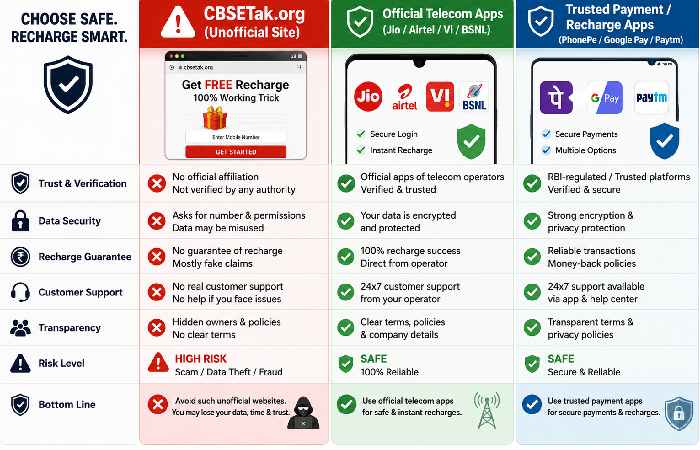
Here’s what separates cbsetak.org from platforms that actually deliver what they promise:
| Feature | CBSETak.org | Official Telecom Apps (Jio/Airtel/Vi) | Established Wallets (Paytm/PhonePe) |
|---|---|---|---|
| Verified telecom partnership | No | Yes — direct operators | Yes — licensed payment platforms |
| Recharge actually delivered | No confirmed reports | Yes — instant confirmation | Yes — instant confirmation |
| Requires personal tasks/surveys | Yes — extensive | No | No |
| Privacy policy | Absent or vague | Published, TRAI-compliant | Published, RBI-compliant |
| Customer support | None | Phone, chat, email, store | In-app chat, email, phone |
| Payment security | No encryption visible | UPI/bank-grade encryption | UPI/bank-grade encryption |
| Owner identity public | Hidden (WHOIS privacy) | Publicly listed companies | Publicly listed companies |
| App store verification | No verified official app | Google Play / App Store verified | Google Play / App Store verified |
That table should make the gap obvious. Legitimate recharge services don’t ask you to complete surveys or watch ads — they process your payment and deliver the recharge. If a platform can’t do that without making you jump through hoops, it’s not a recharge service. It’s an ad-revenue engine wearing a recharge mask.
How to Spot Free Recharge Scams — Red Flag Checklist
CBSETak.org isn’t the only site running this playbook. Dozens of similar domains pop up every month across India. Here’s a five-point checklist you can use on any site that promises free mobile recharge:
- No officially telecom branding No way of confirming partnership through Jio, airtel, Vi and BSNL blogs giveaway free recharges in random blogs and Vlogs If no partnership on the site is verifiable, then that site is surely culprits.
- Hidden domain ownership. Run a WHOIS lookup (you can use whois.domaintools.com for free). If the registrant name, organization, and contact details are all hidden behind privacy protection — that’s a pattern. Legitimate businesses want you to know who they are.
- Task loops with no clear endpoint. You complete one task, then another, then another. The goalpost keeps moving. This is by design — each task generates ad revenue for the site owner.
- No customer support or complaint mechanism. Try finding a phone number, email address, or physical office on the site. If there’s nothing — or if the “contact us” form goes nowhere — you’re not dealing with a real service.
- The site collects your phone number before showing any results. Your mobile number is valuable data. Any site that asks for it before delivering anything in return is collecting, not serving.
Use this as a simple scoring tool:
- 0–1 red flags: still be careful, but verify the offer through your operator’s official app.
- 2–3 red flags: treat the site as unsafe and avoid entering any data.
- 4–5 red flags: close the page immediately, and warn friends or family who might receive the same link.
What to Do Instead of Using the site
Official Telecom Recharge Options
Every major Indian telecom operator has its own app and website for recharges:
- Jio: MyJio app or jio.com — occasionally runs genuine cashback offers through official promotions
- Airtel: Airtel Thanks app or airtel.in — offers reward points through verified programs
- Vi (Vodafone-Idea): Vi app or myvi.in — runs loyalty rewards for existing customers
- BSNL: My BSNL app or bsnl.co.in
You can also recharge through UPI apps like Google Pay, PhonePe, and Paytm — all of which are regulated by the Reserve Bank of India and offer transaction receipts.
How to Report a Scam Website in India
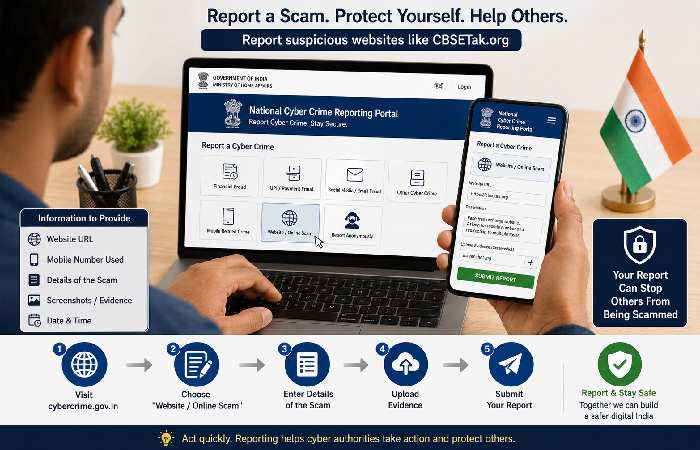
If you’ve already entered your phone number or personal information on cbsetak.org — or any similar site — here’s what to do:
- File a complaint at India’s National Cyber Crime Reporting Portal — this is the official government channel for reporting online fraud
- Call 1930 — the national cyber fraud helpline — especially if you’ve shared financial details or OTPs
- Report the communication through the Sanchar Saathi Chakshu portal — this is specifically designed for reporting fraudulent telecom-related messages and links
- Change your passwords on any account where you used the same phone number or email
- Monitor your bank and UPI accounts for any unauthorized transactions over the next 30 days
Reporting takes about two minutes. And it genuinely helps — complaints feed into pattern-detection systems that flag similar sites faster.
If many users report the same domain, it will be simple for authorities and telecom operators to block links and warn other users.
These are only general safety tips and are not a substitute for specific legal and financial advice by a qualified professional should you have lost a significant amount.
Who Should Avoid this platform
Best for: Nobody — unless you’re a cybersecurity researcher studying scam patterns or a journalist investigating free recharge fraud.
Not for:
- Anyone looking for genuine mobile recharge (use official telecom apps instead)
- Students searching for CBSE results or exam updates (use cbse.gov.in)
- Anyone trying to recover an Instagram account (use Instagram’s official help center)
- Anyone uncomfortable with submitting personal data to an unverified site
- Parents whose children may encounter free recharge links on social media (have a direct conversation about recognizing scam patterns)
For parents, a simple approach is to ask your child to show you any “free recharge” or “password trick” video they see on YouTube or Instagram and talk through why it’s risky. Framing it as “let’s investigate this together” works better than just saying “don’t click anything.
Snapshot: Safer Choices in 30 Seconds
- Avoid entering your phone number or passwords on any site that promises free recharge for all SIMs.
- Recharge only via official operator apps or trusted UPI apps with receipts.
- If you already shared details on this or a similar site, change passwords, scan your device, and file a complaint at cybercrime.gov.in.
Screenshot or share this box with friends or family who are likely to click on such offers.
Final Verdict
This is a content website built to generate ad revenue and collect user data through free recharge promises and viral tech trick claims. It’s not connected to CBSE. It’s not partnered with any telecom operator. And its Instagram password claims contradict how modern, hashed password systems like Instagram’s actually work.
Should you use it? No. The risk-to-reward ratio is entirely one-sided. You spend time, give away data, and receive nothing in return. The site profits from your attention. That’s the entire model.
If you’ve already interacted with it, change any passwords you may have entered, run a security scan on your device, and file a report at cybercrime.gov.in. And if someone sends you a link to a similar site tomorrow — because they will — share this article instead.
Frequently Asked Questions
Is cbsetak org real or fake?
The website is technically real — it exists and loads content. But calling it “real” in the sense that it delivers on its promises would be inaccurate. No independent source has verified that anyone received a genuine free recharge through cbsetak.org. Here, “independent” means sources that do not own or promote the site itself — for example, telecom operators, mainstream news outlets, or recognized consumer‑protection platforms.
The site’s hidden ownership, lack of telecom partnerships, and user complaints all point toward a platform designed to generate ad revenue, not deliver recharges.
Can this platform actually give me free mobile recharge?
Highly unlikely. The pattern across user reports is consistent — you enter your number, complete a series of tasks (surveys, ad views, app downloads), and then get redirected to more tasks. The recharge never arrives. The site can earn money each time you interact with an ad, while users generally report getting no real benefit in return.
Is the site connected to the Central Board of Secondary Education?
No. Not in the least. The official websites of the CBSE are cbse.gov.in and cbseresults.nic.in publicly-and-government- run domains. CBSETak.org was purchased in January 2024 from a commercial registrar, and the use of “CBSE” in its name seems to be a ploy to hack search traffic from students, rather than an indication of formal association.
Can the site find or reset my Instagram password?
It can’t. Instagram uses server-side password hashing — a one-way encryption method that even Instagram’s own staff can’t reverse. No third-party website has the ability to retrieve your password from Instagram’s servers. If a site claims otherwise, it’s either lying to generate clicks or attempting to phish your credentials. Use Instagram’s official account recovery process instead.
How do I report this platform or a similar scam site in India?
Three modes: official channels of consumer protection: complain at cybercrime.gov.in (The National Cyber Crime Reporting Portal), use the 1930 free helpline number to seek immediate redressal against Financial scams, or inform the suspicious link through the Sanchar Saathi Chakshu portal at sancharsaathi.gov.in three of them are government supported and freely available.
Is it safe to enter my phone number on this platform?
Guaranteeing safety is impossible. The site doesn‘t have a clear privacy policy, it doesn‘t tell you who has access to your data, and you are not told what will happen to your phone number once you send it. At minimum, expect spam. At worst, your number could be bundled with other data and sold — or used as part of a phishing campaign targeting your telecom or banking accounts.
Disclaimer: This article is for general information and online‑safety awareness only. It is based on publicly available information and user reports at the time of writing and should not be treated as financial, legal, or personalized security advice.