



Outsource Security Operations Center: Decision Guide (2026)
Many organizations recognize they should have 24/7 cybersecurity monitoring, but very few can actually afford to build it in‑house. Running an internal security operations center demands a minimum of five to six full-time analysts working in shifts, enterprise-grade tools costing six figures annually, and continuous training to keep pace with a threat landscape that evolves daily. For mid‑sized organizations, that typically translates to roughly $1 million to $4 million per year — a level of spend that many IT departments simply don’t have available.
That is exactly why more organizations choose to outsource their security operations center. An outsourced SOC gives you access to round-the-clock threat detection, experienced analysts, and advanced security tools at a fraction of the in-house cost. But outsourcing is not a one-size-fits-all decision, and getting it wrong can leave you more exposed than doing nothing.
This guide breaks down everything you need to evaluate: how outsourced SOCs work, what they actually cost, the risks most vendors won’t mention, and a structured framework for choosing the right provider.
Table of Contents
Key Takeaways
- What is an outsourced SOC? → A managed service where a third-party provider handles 24/7 threat monitoring, detection, and incident response on your behalf
- Why outsource? → Often a substantial cost reduction (commonly around 50–70% vs. in‑house, depending on scope), plus immediate access to expert analysts and enterprise‑grade tools without capital investment.
- Key risks to watch → Vendor dependency, business context gaps, integration challenges, data privacy concerns
- Best for → Organizations under 1,000 employees, teams without dedicated security staff, companies needing 24/7 coverage they can’t staff internally
- How to choose → Evaluate SLAs, technology stack, compliance support, incident response capabilities, and cultural fit
What Is an Outsourced Security Operations Center?
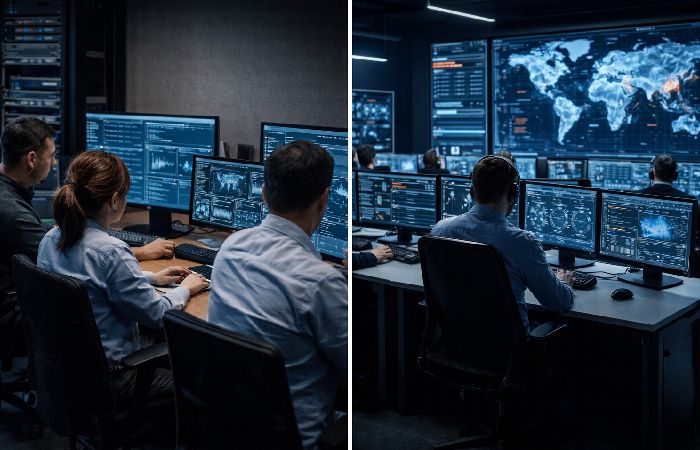
An outsourced security operations center (SOC) is a managed cybersecurity service where a third-party provider — typically a Managed Security Service Provider (MSSP) or Managed Detection and Response (MDR) firm — delivers continuous threat monitoring, detection, analysis, and incident response on behalf of your organization. Instead of building and staffing an internal facility, you subscribe to a service that provides the same capabilities through shared infrastructure and specialized expertise.
This model is commonly referred to as SOC-as-a-Service (SOCaaS).
How SOC-as-a-Service Works

The operational flow of a managed SOC follows a structured detection-and-response pipeline:
- Data Ingestion — The provider collects log data, network telemetry, and endpoint signals from your environment using agents, API integrations, or cloud connectors.
- Continuous Monitoring — A Security Information and Event Management (SIEM) platform aggregates and correlates this data in real time, applying detection rules and behavioral analytics.
- Threat Detection — Automated alerts flag suspicious activity. Advanced providers layer in AI-driven anomaly detection and global threat intelligence feeds.
- Analyst Triage — Trained security analysts investigate alerts, separate true threats from false positives, and assess severity.
- Incident Response — For confirmed threats, the SOC team executes containment actions (isolating endpoints, blocking IPs, disabling compromised accounts) based on pre-approved playbooks.
- Reporting & Improvement — Regular reports provide visibility into your threat landscape, and detection rules are continuously tuned to reduce noise.
This pipeline closely aligns with the Detect, Respond, and Recover functions in the NIST Cybersecurity Framework (CSF 2.0), providing a standards‑backed foundation for your security operations.
Before you plug into a SOCaaS model, it’s worth validating where your controls stand today. A structured SOC assessment can benchmark your existing monitoring, logging, and response capabilities so you know exactly which functions to keep in‑house and which to hand over to a provider.
Key Technologies Behind a Managed SOC
Every credible managed SOC provider operates a technology stack that includes:
| Technology | Function | Why It Matters |
|---|---|---|
| SIEM | Log aggregation, correlation, alerting | Central nervous system of threat detection |
| SOAR | Automated playbooks, orchestrated response | Reduces response time from hours to minutes |
| EDR/XDR | Endpoint and extended detection and response | Visibility into devices, networks, cloud, and email |
| Threat Intelligence | Global feed of indicators of compromise (IOCs) | Identifies known threats before they hit your network |
| AI/ML Analytics | Behavioral analysis, anomaly detection | Catches zero-day and novel attacks that rules miss |
Understanding this stack matters because it determines what questions to ask during vendor evaluation. A provider using outdated SIEM without SOAR integration will struggle to deliver the response times modern threats demand.
Why Organizations Outsource Their Security Operations Center
The decision to outsource SOC operations is driven by three converging pressures that make in-house alternatives increasingly untenable.
The Cybersecurity Talent Crisis
The global cybersecurity workforce shortage has reached critical levels. Industry estimates consistently report millions of unfilled cybersecurity positions worldwide, with demand far outpacing supply.
Here’s the part most articles skip: the talent shortage isn’t just a headcount problem. It’s a capability gap. Even organizations that can afford to hire often can’t find analysts experienced enough to handle advanced persistent threats, cloud-native attacks, or AI-driven intrusion patterns. Research from IBM’s Cost of a Data Breach Report consistently finds that organizations with significant security staffing shortages suffer measurably higher financial impacts from breaches.
IBM’s 2024 data shows that organizations with severe security staffing shortages incurred, on average, about $1.76 million higher breach costs than those with low or no staffing issues.
An outsourced SOC bypasses this problem entirely. You get immediate access to a trained team that already operates at scale.
Cost Efficiency — CapEx to OpEx
Building an in-house SOC requires massive capital investment before a single threat is detected:
- Staffing: 5–6 full-time analysts (minimum) at $80K–$130K each plus benefits = $500K–$900K+ annually
- Tooling: SIEM, SOAR, EDR licenses = $150K–$500K annually
- Infrastructure: Facility, hardware, redundancy = $100K–$300K upfront
- Training & Retention: Certifications, ongoing education, turnover costs = $50K–$100K annually
Total annual cost for a mid-sized in-house SOC: $1M–$4M.
By contrast, outsourced SOC services typically cost $120K–$360K annually for comparable 24/7 coverage. That’s a 60–80% cost reduction while shifting unpredictable capital expenditure to predictable operational spending.
But here’s the cost most organizations miss: the opportunity cost of NOT outsourcing. When your IT team spends 30–40% of their time on security alert triage instead of strategic projects, you’re paying twice — once for distracted IT staff, and again in delayed business initiatives.
24/7/365 Monitoring Without the Overhead
Cyber threats don’t follow business hours. Ransomware deployments, credential theft, and data exfiltration frequently occur during nights, weekends, and holidays — precisely when internal teams are off-shift.
Staffing a true 24/7 SOC internally requires a minimum of four to five shift rotations, accounting for vacation, sick leave, and burnout. For most organizations, that’s simply not viable.
A managed SOC provider spreads this overhead across dozens of clients, making round-the-clock coverage affordable at a fraction of the standalone cost.
Access to Enterprise-Grade Tools and Threat Intelligence
Modern SOC providers operate technology stacks that would cost individual organizations hundreds of thousands annually to license and maintain. More importantly, they maintain threat intelligence feeds aggregated across their entire client base — meaning a threat detected in one client’s environment immediately benefits all others.
This collective intelligence model creates a security advantage that no single organization’s in-house team can match.
In-House SOC vs. Outsourced SOC — Full Comparison
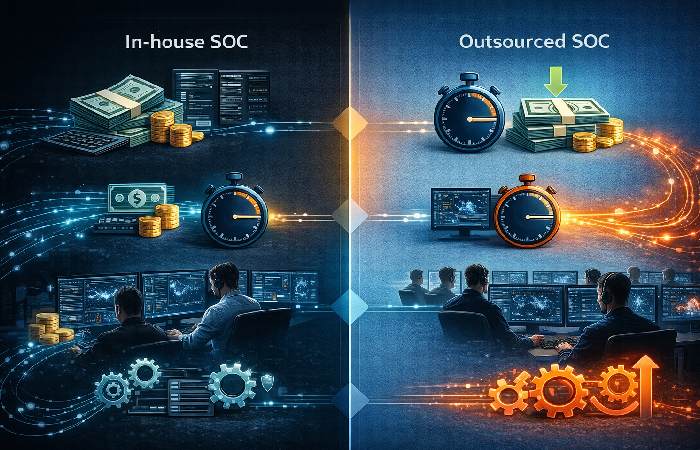
The decision ultimately depends on your organization’s size, budget, regulatory requirements, and risk tolerance. This comparison cuts through the noise:
| Dimension | In-House SOC | Outsourced SOC |
|---|---|---|
| Annual Cost | $1M–$4M+ | $120K–$360K |
| Setup Time | 6–18 months | 2–6 weeks |
| Control | Full control over tools, data, processes | Limited to vendor SLAs and contractual scope |
| Expertise | Constrained by internal hiring success | Immediate access to deep, specialized talent |
| Customization | Highly tailored to internal workflows | May rely on standardized processes |
| Scalability | Requires new hires and infrastructure | Adjustable via service tiers |
| 24/7 Coverage | Requires 4–5 shift rotations (expensive) | Included by default |
| Business Context | Deep understanding of internal systems | Requires onboarding and knowledge transfer |
| Best For | Large enterprises (5,000+ employees) with classified data | SMBs and mid-market organizations needing speed and cost efficiency |
When In-House Makes Sense
An internal SOC may be the better choice if your organization:
- Handles classified or highly sensitive data that cannot leave the environment
- Operates under strict regulatory mandates requiring full internal oversight
- Has 5,000+ employees with budget to sustain a mature security program
- Already employs a CISO and experienced security leadership
When Outsourcing Is the Clear Winner
Outsourcing makes strategic sense when:
- You have fewer than 1,000 employees and no dedicated security team
- Your IT team is stretched thin and spending time on security alert triage
- You need 24/7 monitoring but can’t justify 4–5 full-time shift rotations
- You want enterprise-grade security tools without six-figure licensing costs
- You need to be operational in weeks, not months
Outsourced SOC Service Models Explained
Not all outsourcing arrangements look the same. Understanding the two primary models helps you match the service to your actual needs.
Fully Outsourced SOC
The provider manages all aspects of security operations — monitoring, detection, analysis, response, and reporting. Your internal team receives alerts, reports, and recommendations but does not participate in day-to-day SOC operations.
Best for: Organizations with no internal security staff or those wanting a complete hands-off approach.
Co-Managed (Hybrid) SOC
Your organization retains internal security leadership and handles complex investigations, while the provider manages tier-1/tier-2 monitoring, alert triage, and 24/7 coverage. This model is increasingly popular for mid-market organizations (500–5,000 employees) that want the best of both worlds.
Best for: Organizations with some security maturity that want to augment — not replace — their internal capabilities.
| Feature | Fully Outsourced | Co-Managed (Hybrid) |
|---|---|---|
| Internal Staff Needed | None (security-specific) | Small internal security team |
| Control Level | Provider-managed | Shared responsibility |
| Customization | Standardized | Highly customizable |
| Typical Monthly Cost | $3,000–$15,000 | $8,000–$30,000 |
| Best For | SMBs, organizations without security staff | Mid-market with some internal maturity |
A word of caution on the hybrid model: it sounds ideal on paper, but it often fails when responsibilities between internal and external teams aren’t clearly documented. Ambiguous escalation paths and unclear ownership of incident response decisions create dangerous gaps. If you go hybrid, invest time upfront in a detailed RACI matrix.
How Much Does an Outsourced SOC Cost?
Cost transparency is one of the biggest gaps in competitor content on this topic. Here are actual benchmarks based on industry data for 2025–2026:
Pricing Models
- Flat-Rate Monthly: Fixed fee regardless of data volume. Predictable but may limit scope.
- Per-Device / Per-Asset: Charged per monitored endpoint, server, or data source. Typically $10–$20 per device per month.
- Tiered Packages: Bronze/Silver/Gold models with increasing scope and response capabilities.
Cost Benchmarks by Organization Size
| Organization Size | Typical Monthly Cost | Typical Annual Cost | What’s Included |
|---|---|---|---|
| SMB (50–200 employees) | $3,000–$8,000 | $36,000–$96,000 | 24/7 monitoring, SIEM, basic IR |
| Mid-Market (200–1,000 employees) | $8,000–$20,000 | $96,000–$240,000 | Full monitoring, EDR, threat hunting, compliance reporting |
| Enterprise (1,000–5,000 employees) | $20,000–$50,000+ | $240,000–$600,000+ | Full MDR, custom playbooks, dedicated analyst team |
Key cost factors that influence your quote:
- Number of data sources and endpoints being monitored
- Scope of service (basic monitoring vs. full MDR with active response)
- Compliance requirements (HIPAA, PCI-DSS, SOC 2 add complexity)
- Integration effort with your existing infrastructure
- Service level (response time guarantees, dedicated vs. shared analysts)
How to Choose a Managed SOC Provider — 7-Step Checklist
Selecting the right provider is arguably more important than the decision to outsource itself. Use this structured evaluation framework:
Step 1: Define Your SLAs and Response Time Requirements
- Demand severity-tiered response times (not one-size-fits-all)
- Critical alert acknowledgment: ≤ 15 minutes
- Critical incident response: ≤ 1 hour
- Include service credits for SLA violations
Step 2: Assess Their Technology Stack
- Do they use a modern, cloud-native SIEM?
- Is SOAR integrated for automated response?
- What EDR/XDR platform do they deploy?
- Can their stack integrate with your existing tools?
Step 3: Verify Compliance and Regulatory Support
- Do they hold SOC 2 Type II certification?
- Can they support your specific requirements (HIPAA, PCI-DSS, GDPR, ISO 27001)?
- Do they provide audit-ready compliance reports?
Step 4: Evaluate Incident Response Capabilities
- Request their IR playbooks
- Clarify response authority: what actions can they take without your approval?
- How do they coordinate with your internal team during active incidents?
Step 5: Request Proof of Proactive Threat Hunting
- Do they only react to alerts, or do they actively hunt for threats?
- How often are detection rules tuned and updated?
- What threat intelligence sources do they use?
Step 6: Review Reporting and Transparency
- Do they provide live dashboards with real-time visibility?
- What’s included in monthly reports (metrics, trends, recommendations)?
- How is post-incident root cause analysis documented?
Step 7: Check Cultural and Communication Fit
- How do they handle escalations — phone, email, Slack, ticketing system?
- Do they assign a dedicated account manager or security advisor?
- What does the onboarding process look like?
This checklist aligns with CISA’s cybersecurity performance goals, which emphasize continuous monitoring, incident response planning, and third-party risk management as foundational security practices.
Common Mistakes When Outsourcing SOC Operations
Most outsourcing failures aren’t caused by bad providers. They’re caused by poor decisions on the buyer side.
- Choosing on price alone. The cheapest provider almost always cuts corners — fewer analysts per shift, older SIEM, slower response times. You get what you pay for.
- Skipping the SLA negotiation. Generic SLAs protect the vendor, not you. If response time expectations, escalation paths, and service credits aren’t explicitly defined, you have no recourse when things go wrong.
- Not defining the scope clearly. Which systems are monitored? Which aren’t? Ambiguity here creates blind spots that attackers will find before you do.
- Ignoring the onboarding process. A provider who doesn’t invest time understanding your environment, business context, and risk priorities will generate excessive false positives and miss what actually matters.
- Treating outsourcing as “set and forget.” Even the best managed SOC requires regular review meetings, SLA assessments, and scope adjustments as your business evolves.
Who Should Outsource Their SOC — And Who Shouldn’t
Best For:
- SMBs and mid-market organizations (under 1,000 employees) without a dedicated security team
- Growing companies that need security to scale alongside business expansion
- Organizations with compliance requirements that demand 24/7 monitoring but can’t justify the internal headcount
- IT teams stretched thin where security is a part-time responsibility rather than a dedicated function
Not For:
- Large enterprises with classified or highly sensitive data that cannot be accessed by third parties
- Organizations with mature, well-staffed internal SOC teams already operating effectively at scale
- Companies in industries with strict data residency requirements where sending telemetry to external providers creates regulatory risk
- Organizations unwilling to invest in proper vendor management — outsourcing requires active oversight, not passive delegation
Final Verdict — Is Outsourcing Your Security Operations Center Worth It?
For many organizations — particularly those with fewer than 1,000 employees — outsourcing is often the more practical option. The cybersecurity talent shortage, the cost of 24/7 staffing, and the complexity of modern threat detection make in-house SOCs economically and operationally unfeasible for most businesses.
Outsourcing your security operations center delivers enterprise-grade protection at a fraction of the cost, with faster deployment and immediate access to expertise you’d spend months trying to hire.
The critical element isn’t whether to outsource. It’s choosing the right partner and structuring the engagement correctly. Use the 7-step checklist in this guide to evaluate providers, negotiate meaningful SLAs, and define clear scope boundaries.
If your organization lacks dedicated security staff and operates without 24/7 monitoring today, outsourcing your SOC isn’t just a smart move — it’s an urgent one.
Frequently Asked Questions
Q: What is an outsourced security operations center?
A: An outsourced security operations center is a managed service where a third-party provider handles your organization’s cybersecurity monitoring, threat detection, and incident response on a 24/7 basis. Instead of building internal infrastructure and hiring dedicated analysts, you subscribe to a service that delivers the same capabilities through shared resources and specialized expertise.
Q: How much does it cost to outsource a SOC?
A: Costs vary by organization size and service scope. SMBs typically pay $3,000–$8,000 per month, mid-market organizations pay $8,000–$20,000, and enterprises may pay $20,000–$50,000 or more. By comparison, running an in-house SOC costs $1M–$4M annually for a mid-sized organization.
Q: What is the difference between an MSSP and MDR?
A: A Managed Security Service Provider (MSSP) primarily focuses on monitoring and alerting — they detect threats and notify you. Managed Detection and Response (MDR) goes further by actively investigating alerts and executing containment actions on your behalf. MDR is more hands-on and typically provides faster incident resolution.
Q: Is outsourcing SOC operations safe?
A: Yes, when done correctly. Reputable providers hold certifications like SOC 2 Type II and ISO 27001, implement strict data handling protocols, and operate under contractual SLAs that define data privacy obligations. The key is thorough vendor due diligence before signing a contract.
Q: Can I keep some security functions in-house while outsourcing others?
A: Absolutely. This is called a co-managed or hybrid SOC model. Many mid-market organizations retain internal security leadership for strategy and complex investigations while outsourcing 24/7 monitoring and tier-1/tier-2 alert triage to an external provider.
Q: What should I look for in a managed SOC provider?
A: Focus on six key areas: severity-tiered SLAs with defined response times, a modern technology stack (SIEM, SOAR, EDR/XDR), proven compliance support for your industry, proactive threat hunting capabilities, transparent reporting with live dashboards, and strong cultural and communication fit with your team.